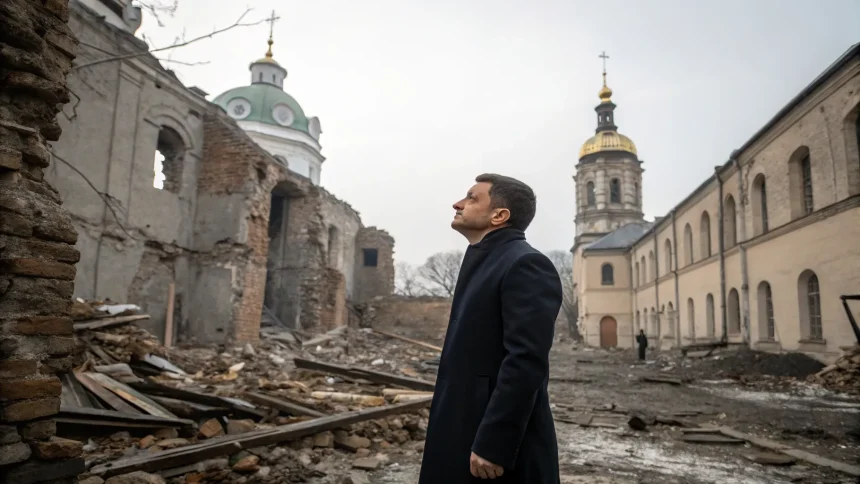
Ukrainian President Volodymyr Zelenskyy on Monday inspected a 1,000-year-old monastery in Kyiv struck during a Russian attack that officials said killed at least five people. His visit put a human face on fresh damage to one of the capital’s oldest sacred sites and renewed questions about how to protect civilians and culture as the war grinds on.
Ukrainian President Volodymyr Zelenskyy surveyed the damage to a 1,000-year-old monastery in Kyiv on Monday following a Russian attack that killed at least five people, according to officials.
Ancient Sanctuary, Modern War
The targeted site is part of Kyiv’s religious and architectural heritage, dating back a millennium. Such monasteries hold deep national meaning, tying present-day Ukraine to its early Christian roots and to the city’s historic role in Eastern Europe. Damage to these landmarks reaches far past bricks and mortar. It strikes at memory, identity, and faith.
Since Russia’s full-scale invasion in February 2022, strikes have hit residential areas, power infrastructure, and cultural institutions across Ukraine. International law seeks to shield cultural property in wartime, including under the 1954 Hague Convention, but enforcement depends on restraint and accountability—two things often in short supply during missile and drone barrages.
What Officials Are Saying
Authorities reported at least five deaths in the latest attack. Emergency crews worked to clear debris and secure the site. Kyiv’s city officials said damage assessments were under way, with engineers examining structural risks and museum staff checking artifacts and icons where possible.
- Fatalities: At least five, according to officials.
- Location: A 1,000-year-old monastery in Kyiv.
- Timing: Monday, during ongoing Russian strikes.
Ukrainian investigators are expected to document the strike pattern and munition fragments, a standard step toward potential war-crimes cases. Russia has often claimed it targets military facilities; Ukrainian officials counter that repeated hits on civilian and cultural sites show a pattern of disregard.
Cultural Heritage Under Fire
Ukraine has pressed global bodies to track wartime losses to historic places. UNESCO has verified damage to hundreds of cultural sites since 2022, from museums to religious buildings. In Odesa, the Transfiguration Cathedral was hit in 2023, drawing sharp international criticism and new calls to shield heritage sites.
Protective efforts have ranged from sandbagging statues to moving icons and manuscripts into secure storage. Yet no archive is proof against a direct hit. The Kyiv strike shows how thin the margin is when air defenses face large volleys of missiles and drones.
Military Stakes and Public Mood
The attack comes as Ukraine seeks more air-defense systems and munitions from allies. Preserving Kyiv’s skyline and sacred sites is not only cultural policy—it is air-defense policy. Every intercepted missile can mean a saved life or an undamaged chapel.
Zelenskyy’s appearance at the monastery signaled attention to both morale and memory. Leaders know that visible stewardship matters in wartime. Visits to damaged schools, hospitals, and churches can rally support at home and abroad, while documenting harm can shape future aid and accountability.
For Russia, hitting the capital tests Ukraine’s defenses and public resolve. For Ukraine, every strike on a landmark risks a symbolic wound that outlasts a single news cycle.
Rebuilding and Safeguards
Restoration will be complex and expensive. Craftspeople may need to source period materials and follow historic methods, often under threat of renewed strikes. International partners, including European cultural funds and diaspora groups, have helped with emergency repairs and digitization projects.
Experts point to a short list of urgent steps:
- Rapid structural stabilization to prevent further collapse.
- Climate control and protective sheeting to shield fragile interiors.
- High-resolution documentation for future restoration work.
- Improved on-site shelters and alarms for staff and visitors.
These measures lower risks but cannot erase them. The balance between access, worship, and safety remains delicate.
Why This Strike Matters
Hitting a thousand-year-old monastery reverberates far outside Kyiv. It sharpens debates on sanctions, weapons deliveries, and the red lines that should protect culture even in war. It also reminds Ukrainians why the fight over territory is inseparable from a fight over history.
As authorities confirm identities of the dead and crews secure the site, attention will turn to repairs and accountability. Expect more calls for air-defense support and for international monitors to track the damage. The next weeks will show whether Kyiv can both patch stones and strengthen shields—preserving lives and a link to a much older past.