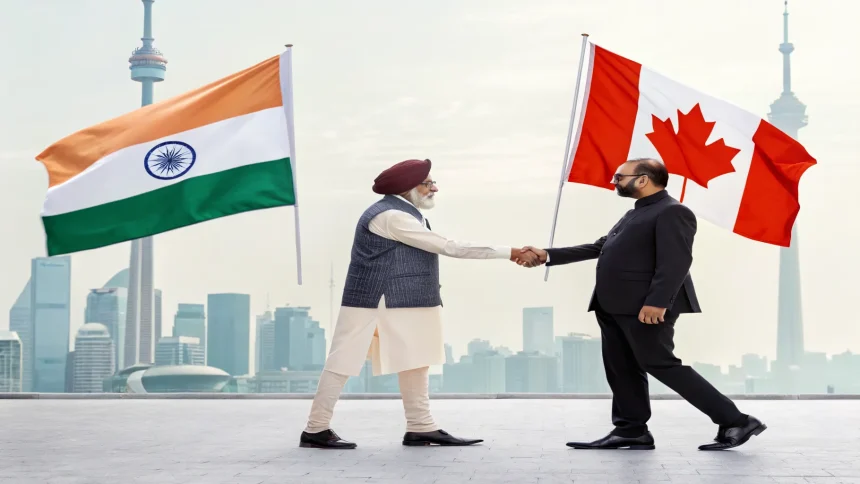
India and Canada signaled an attempt to reset strained ties on Monday, announcing a new roadmap after talks between their foreign ministers in New Delhi. The countries issued a joint statement saying they had agreed to a way forward, aiming to stabilize a relationship shaken by diplomatic disputes and suspended negotiations.
The meeting brought together India’s External Affairs Minister Subrahmanyam Jaishankar and Canada’s Foreign Minister Mélanie Joly. While details were scarce, both sides framed the move as a step to manage differences and rebuild practical cooperation. The announcement follows months of tension that disrupted trade talks, people-to-people ties, and security coordination.
Background: A Relationship Under Strain
Relations deteriorated in 2023 after Canadian Prime Minister Justin Trudeau alleged potential Indian government involvement in the killing of Hardeep Singh Nijjar, a Canadian citizen and Sikh separatist leader, in British Columbia. India strongly rejected the allegation. Each side expelled diplomats, and India briefly suspended visa services for Canadians.
Trade talks for an interim economic agreement were paused, and political dialogue stalled. Security cooperation slowed even as both countries faced transnational crime, disinformation risks, and concerns about foreign interference. Monday’s meeting is the most visible sign of high-level contact since those ruptures.
What The Statement Said—and Didn’t
“India and Canada agreed on Monday on a new roadmap for their relations,” the countries said in a joint statement after talks between their foreign ministers in New Delhi.
The statement did not publish the text of the roadmap or describe timelines. It also did not say whether the two countries resolved the dispute that triggered the breakdown. The lack of detail suggests negotiators may still be working through sensitive issues while trying to prevent further escalation.
Key Issues Likely On The Table
- Security and Law Enforcement: Handling investigations and cooperation on transnational crime while respecting legal processes in both countries.
- Diplomatic Staffing: Restoring normal consular and diplomatic functions after earlier expulsions and staffing reductions.
- Trade and Investment: Re-engaging on a trade track that has been on hold, and providing clarity for investors.
- Mobility and Education: Managing student flows and work permits, areas with large human impact.
People, Trade, and Practical Ties
Canada hosts one of the largest Indian diasporas outside Asia. India has been the top source country for international students in Canada, and many graduates contribute to Canada’s workforce. Any long freeze in ties would affect families, students, and employers on both sides.
Merchandise trade between the two countries has grown over the past decade, though from a modest base. Canadian pension funds and companies have invested in Indian infrastructure and services. India imports Canadian commodities, including pulses and minerals, while exporting pharmaceuticals, machinery, and information technology services.
Analysts See Cautious De-Escalation
Policy analysts say the new roadmap looks like a managed de-escalation. It reduces the risk of further diplomatic steps, such as extended visa limits or new trade barriers. It could also reopen channels for quiet problem-solving, even if public positions remain firm.
Yet obstacles remain. Ottawa’s ongoing investigation into Nijjar’s killing, and New Delhi’s concerns about extremist activity and online incitement, will test any reset. How the two sides handle legal cases and public messaging will shape whether the roadmap holds.
Signals To Watch
Several markers will show if the thaw is real:
- Resumption of structured dialogues on security, agriculture, education, and trade.
- Progress on consular services and the return of normal staffing levels.
- Clear guidance for students and employers on visas, work permits, and processing times.
- Measured public statements that avoid sharp escalations while legal processes proceed.
Possible Path Forward
A practical path could center on guardrails: reaffirming respect for legal independence, setting up joint working groups on migration and public safety, and re-opening technical trade talks. Even modest gains—faster student processing, predictable agri-trade rules, and information-sharing on threats—would signal momentum.
Regional and global issues may also nudge cooperation. Both countries engage with Indo-Pacific partners, worry about supply chain resilience, and weigh critical minerals strategies. Quiet coordination in these areas could build trust without headline risks.
Monday’s announcement marks a pause in a downward spiral, not a full repair. The coming weeks will show whether working-level teams can turn a general pledge into measurable steps. If they do, students, travelers, and businesses could see early benefits. If not, the relationship may slip back into stalemate, with higher costs for people on both sides.