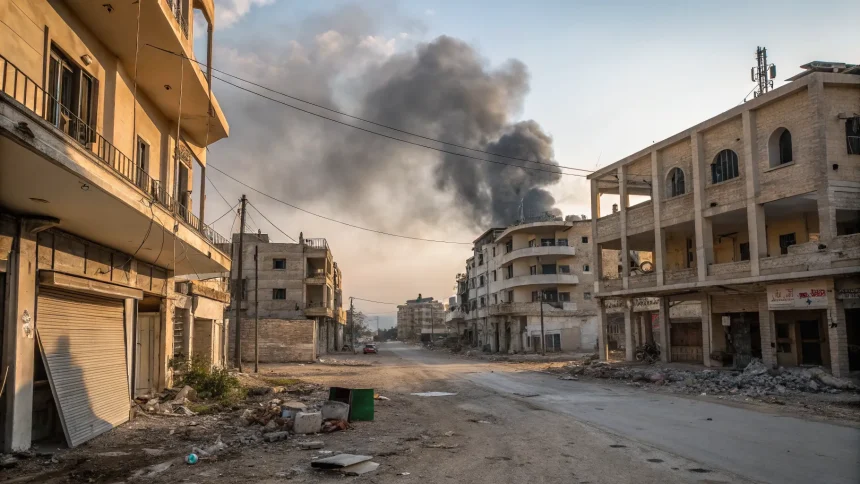
An airstrike hit Beirut’s Haret Hreik neighborhood, with Israeli authorities saying the strike targeted the leader of Hezbollah’s Radwan forces. The incident occurred in the group’s stronghold in the southern suburbs, raising fears of a sharper escalation between Israel and Hezbollah. Details on damage and casualties were not immediately available, and competing narratives are likely as officials assess the outcome.
“The airstrike on the Haret Hreik neighborhood targeted the leader of the Radwan forces, Hezbollah’s elite and battle-hardened fighting unit,” Israeli authorities said.
What Is at Stake in Haret Hreik
Haret Hreik sits in the heart of Beirut’s southern suburbs, an area closely linked with Hezbollah’s political and military apparatus. Past conflicts have drawn strikes to this district, given its strategic and symbolic value. A strike there carries military and political signals, using geography to deliver a message to leadership and rank-and-file supporters.
Targeting a senior figure, if confirmed, would be one of the most sensitive escalations short of open war. It risks deepening a cycle of retaliation along the Lebanon-Israel border and could widen the scope of hostilities beyond sporadic exchanges of fire.
Who Are the Radwan Forces
The Radwan forces are described by Israel and regional analysts as Hezbollah’s elite unit. The group has trained for rapid cross-border raids and complex ground operations. It gained combat experience in Syria during the civil war, according to public assessments by security analysts over the past decade.
Within Hezbollah’s structure, the unit is portrayed as a spearhead for high-risk missions. That reputation makes any claim of targeting its leader significant, both militarily and psychologically.
Historical Context and Recent Flashpoints
Israel and Hezbollah have fought several rounds of conflict since the 1980s. The 2006 war left more than 1,000 people dead in Lebanon and dozens of Israelis killed, according to international reporting from the time. Since then, both sides have tested red lines through periodic strikes and counterstrikes.
In recent years, exchanges along the border have become more frequent when regional tensions flare. Strikes on leadership figures raise the prospect of broader confrontation, even if both sides signal they want to avoid a full-scale war.
Competing Narratives and Verification Challenges
Official claims made soon after a strike are often difficult to verify. Battlefield confusion, operational secrecy, and political messaging can distort early accounts. Independent confirmation of the target’s identity or status may take hours or days, and sometimes never comes publicly.
- Authorities typically release limited details in the immediate aftermath.
- Hezbollah often calibrates its public response, weighing deterrence against strategic ambiguity.
- Third-party monitors may face access and security constraints.
Potential Ripple Effects
If a top Radwan commander was hit, Hezbollah could feel pressure to respond in kind. Retaliation options range from precision fire along the border to longer-range attacks. Each step risks miscalculation. Civilian areas near the frontiers and in Beirut’s suburbs remain vulnerable to spillover.
Regional actors will watch for signs of widening involvement by allied militias, which could stretch already fragile crisis lines across Syria and the eastern Mediterranean. Energy markets and shipping lanes are also sensitive to increased risk in the Levant.
Signals, Deterrence, and Next Steps
The strike appears aimed at deterrence by threatening the leadership tier of an elite force. Whether it achieves that goal depends on Hezbollah’s assessment of costs and benefits. Past episodes show both sides test limits, then seek to reset them through back-channel messages and calibrated retaliation.
Key indicators to track include the speed and scale of any Hezbollah response, statements from Lebanese officials, and Israeli force posture on the northern front. Diplomatic activity by the United States, France, and the United Nations could also point to efforts to contain escalation.
The latest strike marks a dangerous turn in a long-running confrontation. If the target was a senior Radwan figure, the move could reshape near-term deterrence on both sides. If not, the attempt still signals intent to disrupt Hezbollah’s most capable unit. The next days will show whether the exchange remains limited or slides into a wider fight, with civilians again at risk in one of the region’s most volatile flashpoints.