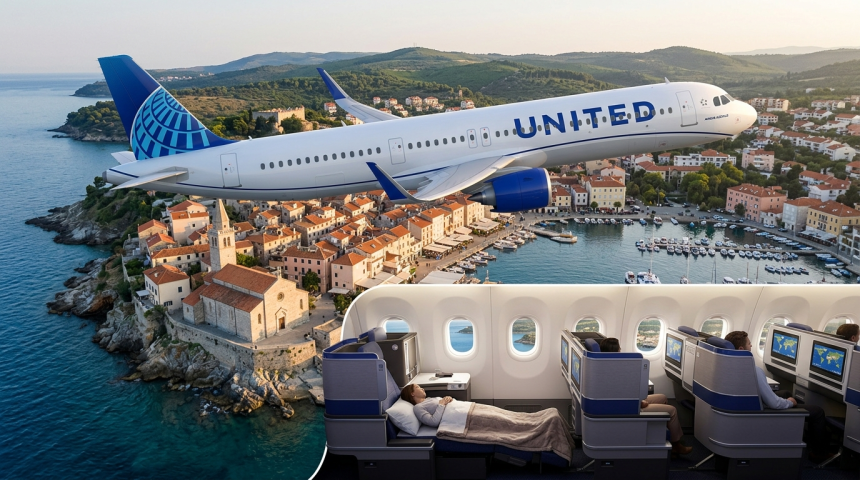
United Airlines is adding the Airbus A321XLR to its fleet, a move designed to give more Americans direct access to smaller European cities. The long-range aircraft will also carry 20 lie-flat Polaris seats, extending United’s premium service to a narrower plane.
The addition could change how the airline builds its transatlantic network. Rather than relying only on large jets flying between major hubs, United can use the A321XLR on routes with lower passenger demand.
A Smaller Jet With Long-Range Ambitions
The A321XLR is a narrow-body aircraft built for longer trips. Its size gives airlines more flexibility than many wide-body jets, which require stronger demand to fill their larger cabins.
For travelers, that could mean fewer connections through Europe’s busiest airports. Smaller cities may gain direct United service from the United States, though the airline has not identified specific destinations or announced a deployment schedule.
“United is adding the Airbus A321XLR to its fleet, which will make it easier for Americans to reach smaller European cities.”
The word “easier” will depend on route choices. A nonstop flight can save hours and remove the risk of a missed connection. Yet service to smaller markets may operate less often than flights linking major hubs.
Polaris Moves Onto a Narrow-Body Aircraft
United plans to install 20 lie-flat Polaris seats on the aircraft. Lie-flat seats are especially valuable on overnight trips to Europe, when passengers may want to sleep before arrival.
The cabin plan shows that United is not treating the A321XLR as a basic short-haul jet with extra fuel. The airline appears to be positioning it as a full transatlantic aircraft, complete with a premium product.
- Twenty lie-flat Polaris seats are planned.
- The aircraft will target long-distance international flying.
- Smaller European markets could gain easier U.S. access.
The premium cabin may also help make thinner routes financially practical. Business-class fares often provide an important share of revenue on international flights. That can matter when a route does not produce enough passengers for a larger aircraft.
More Routes Without More Empty Seats
Wide-body aircraft remain useful on busy services to cities such as London, Paris and Frankfurt. Smaller destinations present a different calculation. Demand may exist, but not enough to support hundreds of seats throughout the year.
The A321XLR offers United a middle path. It can test or maintain a route while limiting the risk of flying too many empty seats. In aviation, empty seats are stubbornly bad customers. They pay no fare and still travel the full distance.
There are trade-offs. Narrow-body cabins usually have one aisle, which can slow boarding and make long flights feel more confined. Travelers will judge the aircraft on seat comfort, cabin layout, schedule and price, not range alone.
United’s decision points to a broader shift in transatlantic travel. Long-range narrow-body jets can connect cities that once required a stop or could not support larger aircraft. The key questions now are where United will fly the A321XLR, how often it will operate, and whether those routes can attract year-round demand.
If the strategy works, the aircraft could expand direct travel options while protecting route economics. For passengers, the practical result may be simple: fewer airport sprints, fewer connections and a flat bed for those occupying one of the 20 Polaris seats.