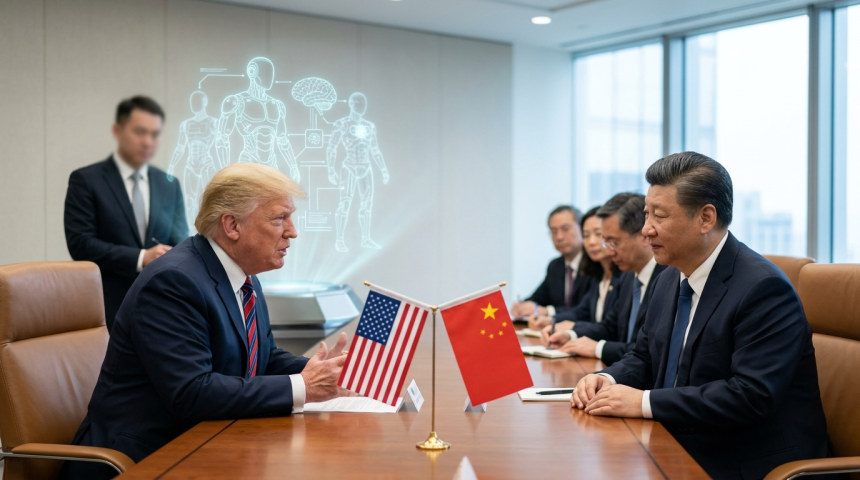
President Donald Trump has announced an “AI Force” as artificial intelligence moves onto the agenda for talks with Chinese President Xi Jinping this week.
The announcement links domestic technology policy with a high-stakes relationship between the world’s two largest economies. It also signals that AI may join trade, security, and industrial policy as a central issue in U.S.-China diplomacy.
Few details were disclosed about the group’s leadership, authority, funding, or membership. That leaves major questions about whether it will advise the president, coordinate federal agencies, or shape negotiations with Beijing.
AI Moves to the Diplomatic Table
Trump’s timing puts the new group in direct view of the planned discussions with Xi. Both governments see advanced technology as a source of economic influence and national power.
Trump announced the creation of an “AI Force” as the technology appeared set to become a key topic with Xi this week.
The talks could cover competition over advanced computer chips, AI systems, research talent, and access to key technology. They may also address the rules that govern powerful AI tools.
Washington must balance several goals. Officials want American companies to compete globally, while limiting security risks and maintaining control over sensitive technology. Those priorities do not always fit neatly together.
China faces a similar calculation. It seeks access to advanced computing resources while supporting domestic firms and maintaining state oversight of AI development.
Questions Surround the AI Force
The name “AI Force” suggests urgency, but its practical role remains unclear. A new White House effort could reduce overlap among agencies. It could also add another layer to an already crowded policy process.
Key unanswered questions include:
- Who will lead the group and report its findings?
- Which federal departments and private companies will participate?
- Will its mission focus on security, economic growth, diplomacy, or regulation?
- How will it measure progress and disclose decisions?
The answers will determine whether the initiative becomes a working policy body or mainly a political signal. In Washington, task forces are easy to announce. Giving them clear authority is the harder trick.
Competition Meets the Need for Guardrails
AI policy presents an unusual challenge because rivalry and cooperation may need to happen at the same time. The United States and China compete for technical leadership, yet both face risks from unreliable or misused systems.
Possible areas for discussion include military uses, automated cyberattacks, false information, and safety testing. Even limited communication could help prevent errors or misread intentions.
Still, any agreement would face deep mistrust. Each side may worry that shared rules could restrict its own companies while giving the other country an advantage. Verification would also be difficult because software can be developed and deployed quietly.
Industry Stakes Extend Past Washington
The outcome matters to chipmakers, software developers, cloud providers, universities, and investors. Government decisions can affect export access, research partnerships, supply chains, and the cost of developing advanced models.
Restrictions could protect sensitive systems, but broad limits may also reduce sales or slow scientific work. Lighter controls could support commerce while increasing fears that advanced tools may reach military or surveillance programs.
Trump’s AI Force therefore arrives with a large assignment and a small public blueprint. The meeting with Xi may reveal whether the initiative is built mainly for international competition or for wider federal coordination.
The next developments to watch are its membership, legal authority, and first policy goals. Clear answers would show that the announcement has operational weight. Without them, the AI Force risks remaining a sharp label attached to an unsettled strategy.