Deep Fission has received safety approval from the U.S. Department of Energy for a nuclear reactor designed to operate at the bottom of a deep borehole. The decision advances the company’s plan to place nuclear equipment underground, where surrounding rock could provide added isolation.
The approval marks an important regulatory step for the proposed design. However, it does not necessarily authorize construction or commercial operation. Nuclear projects often require several reviews covering design, location, environmental effects, security, construction, and operating plans.
A Different Approach to Nuclear Siting
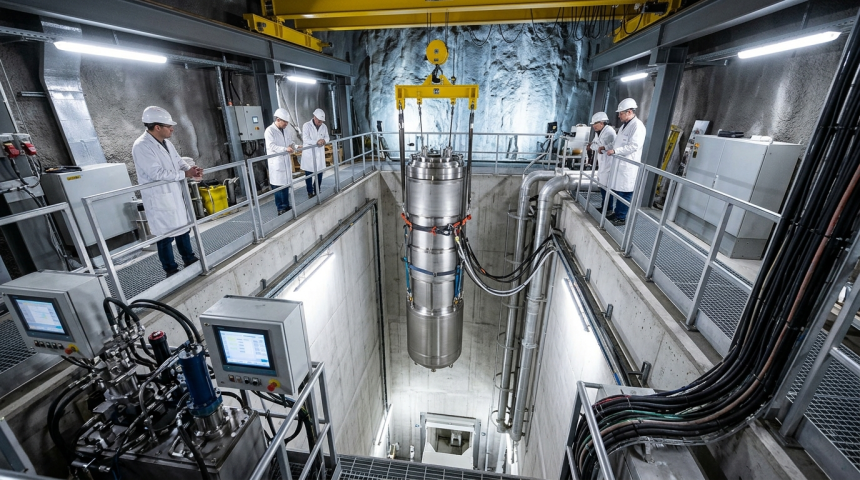
Most commercial nuclear reactors operate inside reinforced buildings at or near ground level. Deep Fission proposes moving key reactor systems far below the surface.
The design seeks to use underground geology as part of its safety strategy. Rock around a deep borehole could create a physical barrier between reactor equipment and communities at the surface. An underground site may also reduce exposure to severe weather and some external threats.
That approach introduces its own engineering demands. Operators would need reliable ways to install, inspect, maintain, and eventually remove or secure equipment deep underground. Emergency planning would also need to account for limited physical access.
What the Safety Decision Means
The Department of Energy’s approval indicates that Deep Fission’s design has cleared a federal safety review within the scope of the company’s application. The precise limits of that approval remain important.
Key questions for the project’s next phase include:
- Which reactor systems and operating conditions the review covered
- Where the first unit could be installed and tested
- Which additional federal, state, or local permits will be required
- How workers would reach and service equipment underground
- How radioactive material would be handled after shutdown
The Nuclear Regulatory Commission normally oversees commercial nuclear power in the United States. The Department of Energy also manages federal research sites, demonstrations, and safety programs. Deep Fission’s regulatory path may therefore depend on where and how its first reactor is deployed.
Safety Benefits and Engineering Questions
Deep underground placement could support passive isolation, limiting reliance on large surface structures. It may also allow projects to use a smaller visible site than conventional nuclear plants.
Yet underground construction does not remove nuclear risk. Heat must still be controlled, radioactive materials must remain contained, and operating data must reach surface teams without interruption. Geological conditions can also differ sharply between locations.
Independent evidence will be needed to show how the design performs during equipment failures, power loss, flooding, seismic activity, or blocked access. Regulators and nearby communities may also seek clear plans for groundwater protection and long-term site monitoring.
A Test for Emerging Nuclear Designs
The project arrives as developers pursue smaller reactors and new construction methods to lower costs and shorten schedules. Many proposals remain in development because licensing, financing, fuel supply, and manufacturing can delay deployment.
Deep Fission’s safety approval gives the underground concept added momentum, but practical results will determine its future. A licensed demonstration would need to prove that borehole installation is economical, repeatable, and safe throughout the reactor’s life.
The next steps will show whether the approval leads to a test installation or a longer review process. Details about the site, reactor capacity, schedule, and remaining permits will offer the clearest measure of progress. For now, the decision moves an unusual nuclear design closer to physical testing while leaving major technical and regulatory questions open.