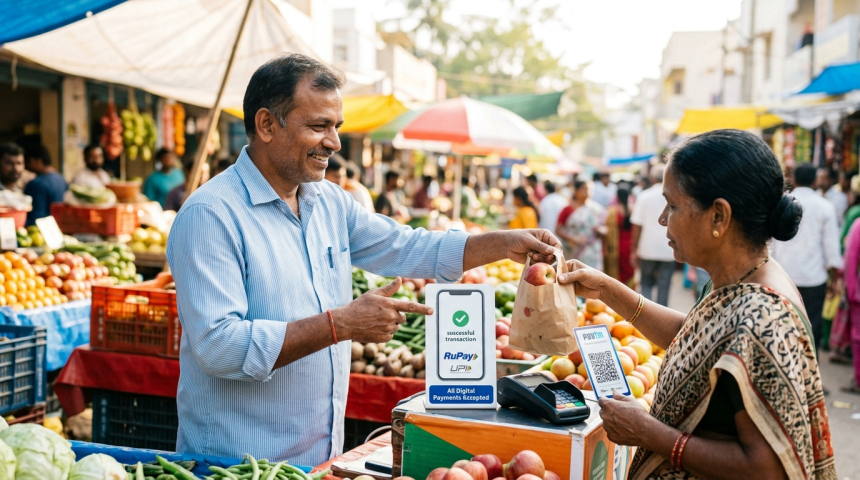
India’s payments operator plans a dedicated fund to help small merchants adopt digital payments, while protecting eligible businesses from added charges.
The National Payments Corporation of India, or NPCI, will finance the fund through merchant discount rate proceeds. The plan targets payment infrastructure in smaller Indian cities and rural areas. Merchants receiving less than Rs 1 lakh each month will remain exempt under the proposed framework.
Funding Digital Payment Infrastructure
The merchant discount rate, commonly called MDR, is a fee linked to payment processing. Under the new framework, part of those proceeds will support services for smaller merchants.
The approach connects payment fees with wider access. Funds could help extend the systems needed to accept and process digital transactions outside major urban centers.
“This fund aims to expand digital payment infrastructure in smaller Indian cities.”
The focus reflects NPCI’s effort to support the long-term operation of the Unified Payments Interface, better known as UPI. The payment network allows users to transfer money directly between bank accounts through mobile applications.
UPI’s reach depends on more than consumer demand. Merchants also need suitable devices, reliable connections and access to payment services. These needs can be harder to meet in smaller cities and rural communities.
Small Merchants Retain an Exemption
The framework draws a financial line based on monthly receipts. Eligible small merchants receiving under Rs 1 lakh per month will remain exempt.
That protection is intended to prevent the smallest businesses from carrying costs that could discourage digital payment acceptance. Such merchants often operate with limited sales and narrow margins.
- The fund will draw money from MDR proceeds.
- Expansion will focus on smaller cities and rural markets.
- Eligible merchants below Rs 1 lakh in monthly receipts will remain exempt.
The exemption also creates an important policy distinction. Larger merchants may contribute through the fee structure, while smaller businesses can gain access without the same direct burden.
Balancing Growth and Financial Support
The plan addresses a central issue for UPI: how to pay for continued expansion while keeping the service affordable. Infrastructure, payment processing and merchant support require sustained funding.
Using MDR proceeds may offer NPCI a dedicated source for those costs. At the same time, the exemption seeks to limit the effect on merchants least able to absorb fees.
The framework may also help narrow the digital payment gap between major cities and less-served markets. Wider merchant acceptance could give consumers more ways to pay and reduce dependence on cash.
However, key details will shape the plan’s results. These include the fund’s size, how recipients are selected, how infrastructure spending is tracked and which transactions generate eligible MDR proceeds. Clear rules will be important for merchants and payment providers.
NPCI’s proposal links UPI’s financial durability with its next phase of geographic growth. The central test will be whether MDR revenue can support wider access without placing new pressure on small businesses. Implementation terms and measurable gains in rural merchant acceptance will be the next developments to watch.