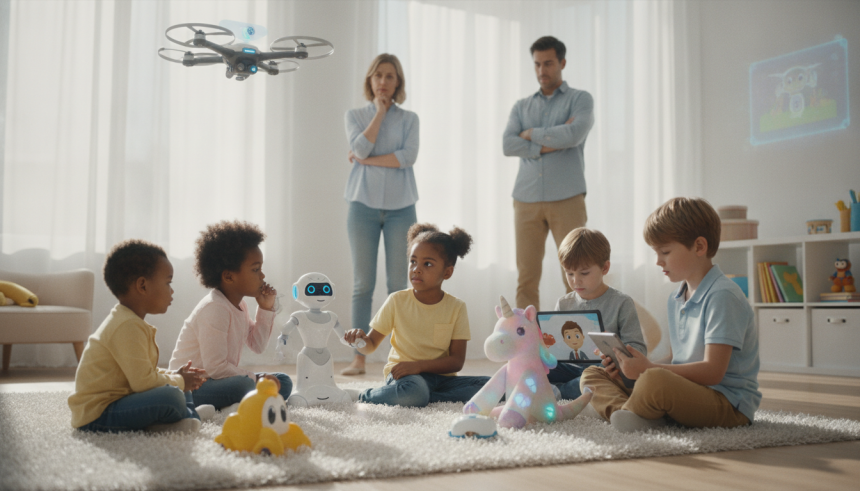
Artificial intelligence is moving into the playroom as companies roll out toys, dolls, and small robots that talk, coach, and comfort. The shift is quick, and it is raising hard questions for parents and educators who wonder how far smart playthings should go.
The new products promise to help with reading, social skills, and even bedtime routines. They are reaching stores and online marketplaces as families look for tools that support learning at home. A leading child-development expert, speaking about the trend, welcomed the promise but warned that the most important bond a child forms is still with people.
AI is moving beyond chatbots and into toys, dolls, and robots built to befriend children.
A leading child-development expert says the technology offers real promise, but also risks crowding out the human relationships children need most.
From Talking Dolls To Social Robots
Smart toys are not new. Decades ago, electronic pets and talking dolls introduced children to responsive play. Products such as Furby and Tamagotchi set the stage for more advanced devices that listen and reply.
In recent years, home assistants and phone apps have trained families to speak to machines. Toy makers and startups now add microphones, cameras, and language models to child-focused products. Robots like Moxie, marketed as a social companion for children, show how far the category has moved. Earlier, My Friend Cayla drew government scrutiny in Europe for privacy risks, signaling the stakes when toys connect to the internet.
What AI Promises In The Playroom
Supporters say these devices can coach reading and math with feedback tailored to each child. They can role-play social situations and offer patient practice for shy kids. They are available at any hour, which makes them easy to use in busy households.
Educators note that repetition and quick feedback can build skills. A small robot that celebrates small wins may keep a child engaged longer than a workbook can. For children with special needs, a predictable, nonjudgmental partner may lower stress and help them try new tasks.
Risks To Relationships And Development
Experts warn that children learn most from people. They copy tone, eye contact, and empathy from parents and peers. If a toy fills too much of that space, the child may miss key practice with real emotions.
There is also the issue of attachment. If a device presents itself as a friend, a child may build a bond with a system that cannot truly care. That can confuse expectations of friendship. It can also change how a child handles conflict and repair, skills usually learned with people.
Some psychologists add that open-ended play, like building forts or making up games, is central to growth. A toy that always talks may crowd out silence, boredom, and imagination, which are useful for problem-solving.
Privacy, Safety, And Design Choices
The rise of connected toys draws attention to data. Many devices collect voice recordings and usage logs. Parents often cannot see how long data is kept or where it is sent. Past recalls and fines show what happens when security is weak.
Advocates press for safer defaults. They urge local processing, clear data deletion options, and child-friendly content filters. They also call for strict age checks and limits on advertising in child-directed tools.
- Tell families when recording is on.
- Store the least amount of data needed.
- Make off switches clear and physical.
- Allow easy review and deletion of child data.
What Parents And Schools Can Do Now
Families can set rules that keep people first. Short, supervised sessions help ensure that the device supports, not replaces, parent time. Rotating toys can prevent one device from becoming the main companion.
Schools can treat AI toys like any tool. They can set goals, test outcomes, and watch for side effects, such as less group talk. Clear policies on data and device use can protect students and teachers.
The Market And What To Watch
Retailers report growing interest in interactive learning tools. Startups pitch subscriptions that update a toy’s skills each month. Larger brands test features that link a doll’s voice to cloud-based assistants.
Regulators are active. Privacy agencies in the United States and Europe have warned companies to follow child data laws. Consumer groups continue to test toys and publish safety grades. Class-action suits over voice data suggest that legal risk is rising.
Researchers are studying how children respond to machine companions over months, not minutes. Early projects compare outcomes for reading, empathy, and sleep. Results could guide which designs help and which ones should be limited.
The expert caution remains clear. Smart toys may help practice skills and reduce friction at home. Yet the core task for adults is to protect time for human conversation, play, and care. The next wave of products will likely push deeper into friendship and tutoring. Parents, teachers, and makers will need to decide how these tools fit into a child’s day, and how to keep the child’s closest bonds at the center.