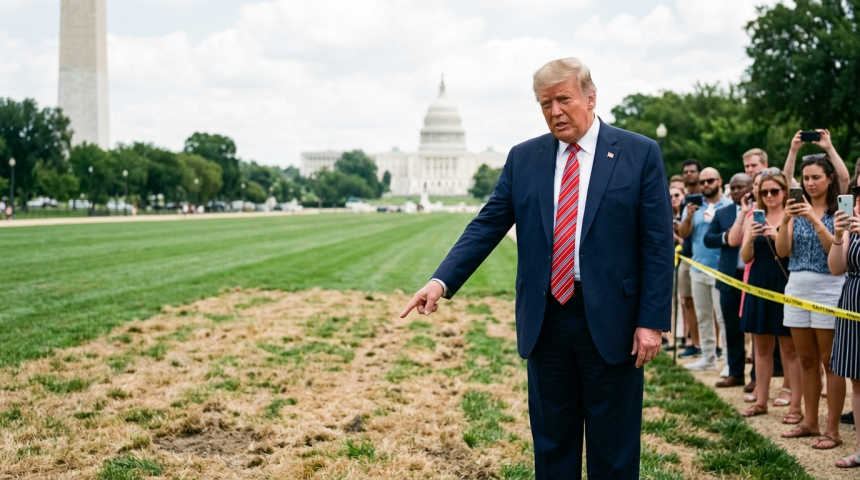
President Donald Trump blamed “VANDALS” for apparent grass damage on the National Mall in an Aug. 16 social media post, but offered no evidence supporting the claim.
The accusation focused attention on a highly visible public space in Washington. Yet the post did not identify any suspects, explain when the damage occurred, or show that vandalism caused it.
An Accusation Without Supporting Details
Trump used capital letters to describe those he believed were responsible:
“VANDALS”
The wording framed the damaged grass as an intentional act. However, no supporting account from investigators, witnesses, or National Mall officials accompanied the claim.
That gap matters because damaged turf can have several causes. Heavy foot traffic, public events, maintenance work, vehicles, weather, and deliberate destruction may leave similar signs.
The post also left several basic questions unanswered:
- What specific area of grass was damaged?
- When did the apparent damage occur?
- Was the site inspected by authorities?
- Was there evidence of intentional conduct?
Without those details, the cause cannot be confirmed from Trump’s statement alone. A photograph or visual impression may document a result, but it does not always establish who caused it.
A Prominent Public Space
The National Mall contains some of the country’s most familiar monuments and civic gathering places. Its lawns regularly host demonstrations, ceremonies, festivals, tourists, and large crowds.
That intense use can make grass care a recurring public concern. Even ordinary wear may become politically charged because the Mall carries national meaning and sits at the center of federal Washington.
Intentional vandalism would present a different issue from routine damage. It could prompt an investigation, repair costs, or added security. Those responses would usually depend on verified facts rather than an unsupported accusation.
Social Media Speeds Claims Ahead of Facts
Trump has long used social media to speak directly to supporters and shape public debate. Short posts can draw swift attention, especially when they assign blame in blunt terms.
That speed comes with a trade-off. A forceful claim may spread before agencies can inspect a location, gather video, interview witnesses, or release findings. Capital letters can raise the temperature, but they cannot mow down uncertainty.
The episode also shows the difference between observation and attribution. Apparent damage may be visible. Deciding that vandals caused it requires separate evidence about intent and responsibility.
What Could Establish the Cause
A firm conclusion would likely require information from officials responsible for the Mall or from law enforcement. Relevant material could include inspection reports, surveillance footage, witness accounts, event records, or maintenance logs.
Until such evidence is released, Trump’s statement remains an allegation rather than a verified finding. Any official assessment may confirm vandalism, identify another cause, or leave the matter unresolved.
The immediate takeaway is narrow but important: grass appeared damaged, and Trump publicly blamed vandals without showing proof. The next development to watch is whether federal officials provide evidence that supports or contradicts his account.