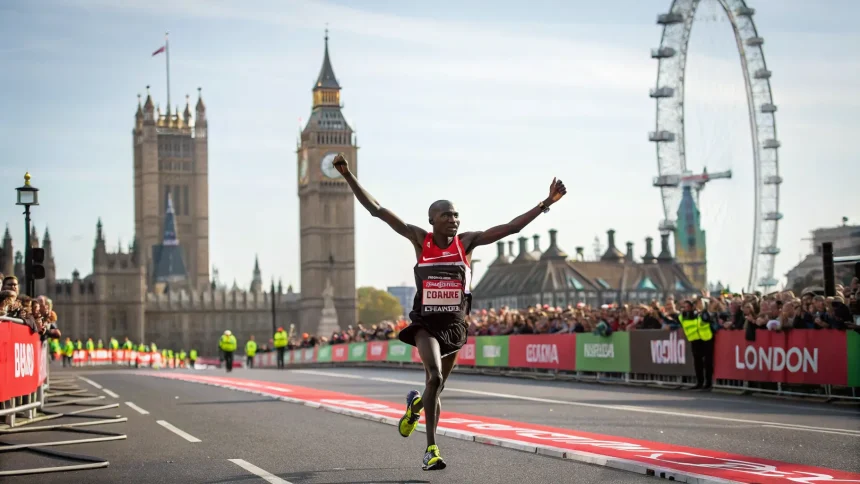
East Africa’s marathon legacy gained a new chapter as Kenyan runner Sabastian Sawe delivered a breakout performance at the London Marathon, challenging long-held limits on the 26.2-mile race. The performance, in London before a global audience, sharpened focus on a region that has shaped distance running for decades and raised fresh questions about what the men’s marathon can be.
Details of Sawe’s exact splits and placing were not immediately released, but the impact was clear. Race observers described a surge that reset expectations for elite pacing and late-race strength. In the words of one assessment:
“Sabastian Sawe produced a stunning breakthrough at the London Marathon, redefining what was thought possible over the marathon distance.”
That assessment matched the reaction from coaches and athletes who view London as both a stage and a barometer. It is a fast course with a deep field, and strong runs there often shape national team selections and shoe-company strategies for the year ahead.
East Africa’s Enduring Grip on Distance Running
Sawe’s rise fits a familiar pattern. Runners from Kenya and Ethiopia have dominated major marathons and world records for more than two decades. Training at altitude, deep competition at home, and strong club systems have created relentless pipelines of talent.
Icons such as Eliud Kipchoge and the late Kelvin Kiptum set new standards. Kipchoge pushed the world record into uncharted territory. Kiptum’s course record in London and his world mark in Chicago accelerated the men’s field further. Sawe steps into that context with a performance that invites comparison without the burden of claims about records or titles.
What Made This Run Stand Out
Coaches watching the race pointed to three themes that separate contenders from champions: even pacing, tactical patience, and resilience in the final 10 kilometers. Sawe’s effort, by their account, touched each area.
- Even pacing against a crowded lead pack can limit late fade.
- Positioning near trusted pacers keeps runners out of erratic surges.
- Fueling discipline often decides the final miles.
London is notorious for fast openings followed by attrition. A runner who manages the middle third can gain minutes late. Sawe’s display suggested he handled that critical phase with maturity, a sign of marathon-specific growth rather than raw speed alone.
Shoes, Surfaces, and Strategy
Footwear remains part of the debate. Superfoam midsoles and stiff plates have changed efficiency for elites. Some scientists say energy return improves late-race form; others point to training adaptations as the key driver. Sawe’s run lands in the middle of that conversation and will add fresh data as brands analyze splits and motion capture.
Weather and course conditions also matter. London’s mix of riverfront winds, turns, and crowd energy can lift or blunt a move. If the day brought cool air and steady breezes, it would favor aggressive pacing. The tactical read of those cues—when to cover, when to wait—often decides podium order.
The Human Pipeline Behind the Moment
Sawe’s path reflects the depth of East African training groups, where marathoners sharpen speed at 5,000 and 10,000 meters before stretching to the road. Group sessions at altitude build durability, while internal trials keep athletes honest. Coaches often insist on years of base work before an athlete takes a major city start line.
That system produces waves of runners ready to step up when stars fade or skip a race. It also means one breakthrough can ripple across squads as training partners raise their aims. Sawe’s leap will likely trigger lineup decisions by national selectors and managers planning the next cycle of majors.
What This Means for the Men’s Marathon
Sawe’s performance adds urgency to a men’s field already dense with talent. Deep packs now race within seconds through 35 kilometers. That density makes tactical errors more costly and rewards those who can close hard under two hours and five minutes.
For fans and sponsors, the message is clear. The men’s marathon is in a tight competitive window, where the margin between a breakthrough and a fade is small. Training, tech, and race-day choices now carry greater weight.
Sawe’s day in London signals that the next wave is arriving even as the sport still mourns Kiptum and measures Kipchoge’s late-career form. The takeaway is less about a single time and more about a standard of execution. Expect selectors to weigh this run in future team choices. Expect rivals to adjust pacing plans. And expect London’s streets to remain a proving ground for what the marathon can be.