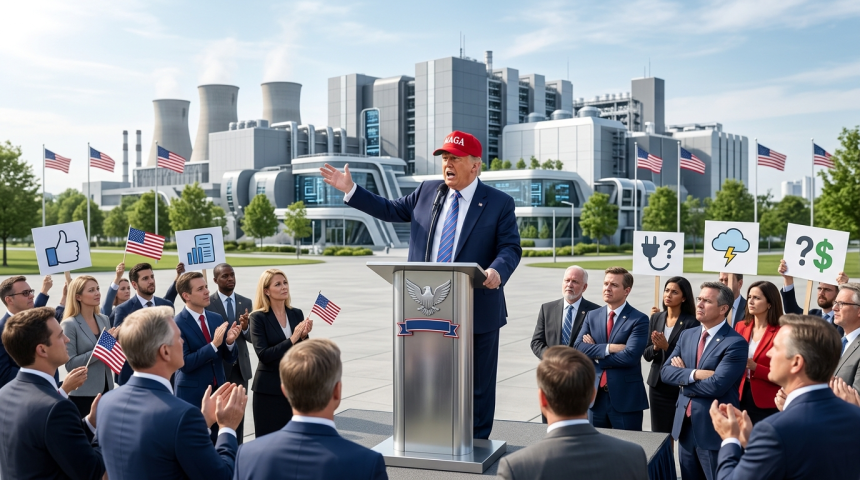
President Donald Trump’s strong support for AI data centers is emerging as a political risk for Republicans ahead of the 2026 midterm elections.
The president has promoted the large computing facilities even as they face public criticism over electricity use, local development, and their effect on nearby communities. His approach could force Republican candidates to balance the White House’s technology agenda against concerns voiced by voters at home.
A National Priority Meets Local Resistance
AI data centers contain powerful computer systems used to train and operate artificial intelligence models. They require major investments in buildings, chips, cooling equipment, and energy infrastructure.
Supporters view these projects as a source of construction work, tax revenue, and American leadership in AI. They also argue that domestic computing capacity can reduce reliance on foreign technology and support national security.
Critics focus on costs that often appear closer to home. Large facilities can increase demand for electricity and water. New transmission lines, power plants, and utility upgrades may also become part of the debate.
That split creates a familiar political problem. The economic gains may be spread across a state or the country, while disruptions can fall on one town, county, or utility district.
Why Republicans May Feel Pressure
Trump’s enthusiastic advocacy ties the Republican brand more closely to the industry. That link may help candidates who want to campaign on investment, jobs, and competition with China.
Yet it could complicate races where proposed facilities are unpopular. Republican candidates may face questions about who pays for grid upgrades, how many permanent jobs projects create, and whether residents receive enough protection.
The main political tensions include:
- Higher power demand and possible pressure on household utility bills
- Water use for cooling in areas facing limited supplies
- Noise, land use, and construction near residential communities
- Tax incentives offered to wealthy technology companies
- Promises of jobs compared with long-term local employment
These are practical concerns rather than simple arguments for or against AI. A voter can support American technology growth while opposing a project planned near a home, farm, or strained power grid.
Midterm Politics Could Shape the Debate
Midterm elections often turn on local costs and voter frustration with the party holding the White House. That makes Trump’s position especially important for Republicans defending competitive seats.
Democrats could use data center disputes to attack corporate subsidies or rising infrastructure costs. Republicans, meanwhile, could frame the projects as necessary investments that keep jobs and sensitive technology inside the United States.
Neither argument settles the central policy questions. The political outcome may depend on whether officials can show clear community benefits, disclose resource demands, and prevent ordinary customers from carrying unfair costs.
Permits and Power Bills Offer the Next Test
The issue is likely to become more visible as projects move from announcements to permit hearings and utility planning. Ribbon cuttings make easy photographs. Power bills and zoning meetings tend to produce harder questions.
Republican unease may grow if Trump keeps promoting data centers without addressing those local concerns. It may ease if new projects deliver jobs, tax income, and reliable energy without shifting large expenses to residents.
For now, Trump has placed AI infrastructure inside the midterm conversation. The next test will be whether Republican candidates repeat his enthusiasm, seek stricter conditions, or quietly create some distance before voters decide.