As Silicon Valley races to build an artificial-intelligence future, a growing group of hobbyists is saving the machines that started the digital revolution.
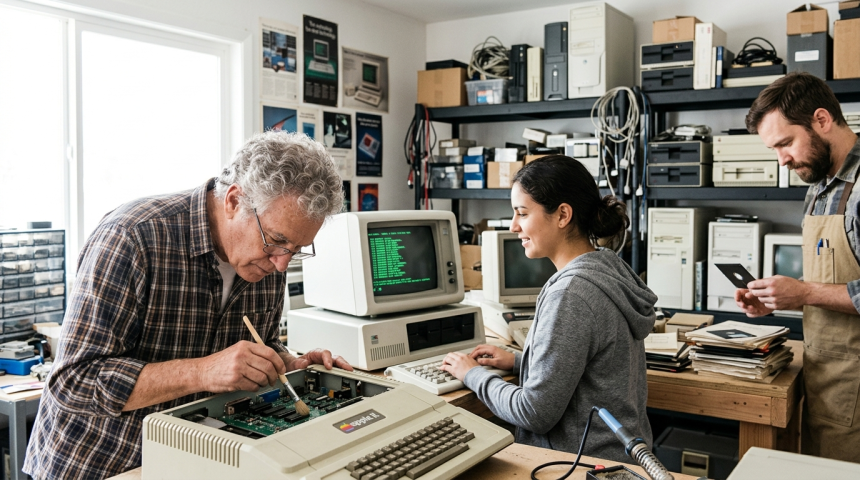
The preservation effort is unfolding through home workshops, collector groups, museums, and online communities. Participants restore aging computers so future generations can see how modern technology took shape.
The timing carries urgency. Early machines are growing harder to repair as chips fail, storage media decay, and replacement parts disappear. Without careful work, much of computing history could become impossible to operate.
Old Machines Face a New Deadline
Classic computers were not designed to survive for many decades. Batteries can leak, plastic can become brittle, and capacitors can fail. Magnetic disks and tapes also deteriorate.
Collectors often search for original parts before turning to modern replacements. That choice can create a tension between historical accuracy and practical survival.
A computer kept entirely original may eventually stop working. A restored model may run well but contain newer parts. Preservationists must decide whether the machine, its operation, or both matter most.
The work demands patience. A forgotten computer found in an attic may look intact while hiding corrosion inside. Switching it on without inspection can turn a repair project into a smoke machine.
Preserving More Than Hardware
The effort also covers software, manuals, advertisements, packaging, and personal stories. Hardware alone cannot explain how people once learned, worked, and played on these systems.
Early software often exists on fragile media and may depend on uncommon drives. Preservationists copy those files before they vanish. They also document operating steps that once seemed obvious but are now unfamiliar.
Key preservation goals include:
- Repairing original computers and peripherals
- Copying software from aging disks and tapes
- Scanning manuals and technical documents
- Recording the experiences of users and engineers
Emulation offers another route. It allows newer hardware to imitate an older computer, giving researchers and the public access without placing rare equipment under constant strain.
Yet emulation cannot reproduce every physical detail. The weight of a keyboard, the sound of a disk drive, and the delay of an old screen shaped the user experience.
AI Growth Sharpens the Contrast
The preservation movement stands in sharp contrast with Silicon Valley’s focus on AI. Current systems rely on huge computing resources, while many classic machines operated under strict memory and processing limits.
Those limits forced programmers and designers to make careful choices. Studying their solutions can offer useful lessons about efficiency, repair, and long-term access.
The contrast also raises a wider question about the technology industry’s memory. Companies often reward rapid development, but quick product cycles can leave yesterday’s tools undocumented and unsupported.
Classic computers show that innovation rarely arrives from nowhere. Modern interfaces, games, personal software, and networked communication grew from years of experiments, including plenty that failed.
A Community Keeps History Running
Hobbyists play a central role because many surviving systems sit outside formal collections. Private owners may hold rare models, obscure software, or documents unavailable elsewhere.
Museums can provide professional conservation and public access. Independent collectors can move faster, trade parts, and develop repair knowledge around specific machines. The two approaches can support each other.
Access remains an important concern. A restored computer hidden in storage preserves an object, but public demonstrations and digital archives preserve its meaning.
The AI boom may define Silicon Valley’s next chapter, but hobbyists are working to keep earlier chapters readable. Their task is not simply nostalgic. It protects evidence of how computing became personal, widespread, and powerful.
What happens next will depend on parts, documentation, and cooperation. Each successful restoration buys time, while each lost disk narrows the record. The future of computing history, oddly enough, may rest with people skilled at repairing its past.