Mount Kailash continues to draw travelers seeking spiritual renewal on one of Asia’s most demanding high-altitude journeys.
The mountain rises in western Tibet, north of the Nepal border. For many visitors, reaching this remote area is a rare religious journey rather than a standard climbing trip.
The route combines physical strain, uncertain weather and deep religious meaning. Its remote location also requires careful planning, permits and support from experienced local operators.
A Sacred Mountain for Several Faiths
Mount Kailash holds religious importance for Hindus, Buddhists, Jains and followers of Bon. Each tradition connects the mountain with sacred teachings, divine figures or the origins of spiritual life.
Hindus associate Kailash with Lord Shiva. Tibetan Buddhists link it to Demchok, a figure representing spiritual joy. Jain tradition identifies the area with the liberation of its first teacher, Rishabhanatha. Bon followers also regard the mountain as holy.
This shared importance has made Kailash a major pilgrimage site. Travelers usually complete a circular route around the mountain rather than attempting to reach its summit.
For many, the journey is “a once-in-a-lifetime trip to find spiritual awakening.”
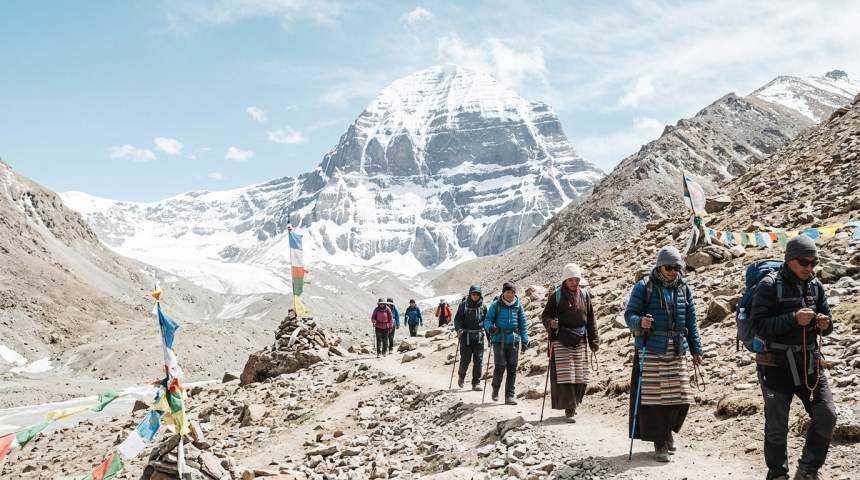
The circuit, often called a kora or parikrama, is an act of devotion. Some pilgrims walk it once. Others repeat the route or perform full-body prostrations along the trail.
Altitude Shapes the Experience
The Kailash journey tests visitors with thin air, steep paths and rapid weather changes. Much of the pilgrimage takes place at elevations where oxygen levels are far lower than at sea level.
Dolma La, the highest pass on the usual circuit, rises above 5,600 meters. Crossing it can be difficult even for healthy and experienced hikers.
Common risks include altitude sickness, dehydration, exhaustion and sudden cold. Proper acclimatization can reduce danger, but it cannot remove it.
- Travelers need time to adjust to high elevation.
- Weather can change quickly along the route.
- Medical care is limited in remote sections.
- Religious customs require respectful conduct.
The physical challenge can strengthen the journey’s spiritual meaning. Pilgrims often see hardship as part of reflection, sacrifice and personal change.
Access Requires Careful Planning
Visitors may approach the region through Nepal or other authorized routes into Tibet. Travel rules depend on nationality, border conditions and permit policies.
Independent access is often restricted. Many foreign travelers must join an organized group and follow approved schedules. Political conditions, road closures and severe weather can also disrupt plans.
These limits affect nearby tourism businesses, guides and communities that depend on seasonal visitors. At the same time, controlled access may help reduce pressure on fragile mountain environments.
Respecting a Place of Worship
Mount Kailash is not treated as a conventional mountaineering objective. Climbers generally avoid the summit because of its sacred status and restrictions on climbing.
That distinction matters as remote travel gains wider interest. Visitors seeking photographs or personal achievement share the route with people performing serious acts of faith.
Responsible travel includes following local guidance, limiting waste and avoiding behavior that disrupts worship. It also means recognizing that the mountain’s value cannot be measured only through tourism.
Mount Kailash remains a demanding destination shaped by faith, geography and government controls. Future access will depend on permit rules, regional conditions and environmental protection. For pilgrims, however, its central purpose remains clear: the journey is an act of devotion, with the mountain approached as sacred ground rather than conquered as a summit.