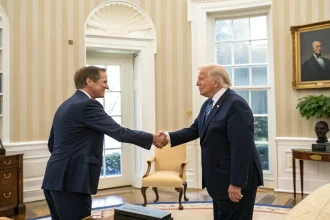
President Donald Trump said Thursday that Intel has reached an agreement with Apple to make computer chips in the United States, hinting at a rare reshaping of the tech supply chain. The claim, made without further detail, signals a possible shift for one of the world’s most valuable companies and a boost for domestic chipmaking amid geopolitical tension and supply worries.
“Intel has struck a deal with Apple to start producing computer chips in the United States.”
The statement did not include timelines, chip types, or plant locations. Neither Apple nor Intel immediately confirmed the deal. If accurate, the move would mark a significant step for U.S. manufacturing and for Intel’s foundry ambitions, while challenging the current model that keeps most advanced chip production in Asia.
Why This Matters Now
Semiconductors power phones, laptops, data centers, and cars. The pandemic-era shortages exposed how fragile the supply chain can be. Washington has since poured billions into domestic production to reduce reliance on overseas foundries.
Congress passed the CHIPS and Science Act in 2022, including tens of billions in grants and tax credits for U.S. facilities. Intel has announced new plants in Arizona and Ohio, though building and qualifying advanced fabs takes years and vast capital. Apple, meanwhile, designs its custom M- and A-series chips but relies on Taiwan Semiconductor Manufacturing Co. (TSMC) to make them, often on the most advanced processes.
Intel’s Foundry Push Meets Apple’s Hardware Strategy
Intel has been trying to grow as a contract chipmaker through its Intel Foundry Services. It has inked partnerships with firms like MediaTek and has courted large customers that design their own chips. Winning Apple would be a marquee validation of that strategy.
Apple shifted its Mac line to in-house silicon to control performance and power use. Outsourcing production to TSMC let Apple ride the most advanced process nodes. Bringing some production stateside could add supply resilience and political goodwill, but it would need to meet Apple’s strict performance and yield targets.
Open Questions and Possible Scenarios
Trump’s claim leaves key points unanswered. Apple uses different chips across products, from high-end processors to supporting components. Not all require the same level of cutting-edge fabrication. Intel could, in theory, start with less advanced parts or prepare for future Apple designs once new fabs come online.
- Which chips: flagship processors, support chips, or modems?
- Which fabs: current Arizona facilities or future Ohio plants?
- What timeline: pilot runs first, or immediate volume?
Another factor is supplier mix. Apple rarely relies on a single source for long. A split strategy could keep TSMC on leading-edge nodes while moving select parts to U.S. lines, if the economics and yields work.
Industry Impact and Policy Backdrop
A deal would signal momentum for U.S. chipmaking goals. It could also pressure rivals to expand stateside. TSMC is building in Arizona, though timelines have shifted as it brings advanced equipment and skilled labor online. Samsung is expanding in Texas with support from the same federal incentives.
For Intel, a major customer would help fill fabs and spread costs, aiding its turnaround. For Apple, domestic production could cushion supply risks tied to geopolitics and logistics. Consumers might not see immediate price changes, but steadier supply during shocks would be a quiet win.
What Experts Will Watch
Analysts will look for confirmation from both companies, specifics on process nodes, and any mention of volume commitments. They will also scan for federal support tied to the CHIPS Act and state-level incentives. Engineering milestones, like successful test wafers and yield improvements, will be the real proof.
Labor and tooling remain hurdles. Advanced fabs need skilled technicians and a tight network of suppliers. Delays can push schedules, and even small yield swings change the math. If Apple brings advanced designs to U.S. soil, it suggests confidence that these hurdles can be managed.
Trump’s statement points to a potential shift with wide ripple effects. If Apple and Intel confirm details, it would mark a new phase for American chip production. If not, the comment still underscores the pressure on tech giants to build closer to home. Watch for official announcements, site details, and the first wafers off the line. The promise is big; the proof will be in the chips.