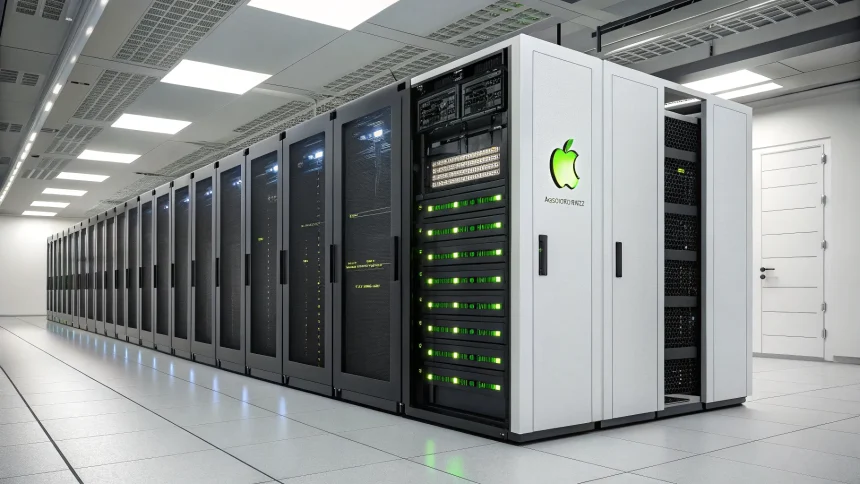
In a notable move linking two of the world’s most valuable tech companies, Apple said its new Apple Intelligence services will run server-side on Nvidia GPUs, an announcement delivered at WWDC. The plan signals how Apple will scale its AI features by tapping Nvidia’s data center hardware, blending on-device capabilities with cloud processing to deliver more complex responses and faster performance.
The decision comes as demand for generative AI grows across consumer devices and enterprise platforms. It positions Nvidia deeper in the smartphone and personal computing market, while giving Apple a path to support heavier AI tasks beyond the limits of local chips. The approach could speed rollouts and broaden features for millions of users once Apple Intelligence becomes widely available.
What Was Announced
“NVIDIA GPUs to support server-side inference for Apple Intelligence, announced at WWDC.”
The announcement ties Apple’s consumer-facing AI to Nvidia’s accelerator hardware in the cloud. Server-side inference refers to running AI models on remote machines rather than only on the device. It can handle more complex prompts, longer context, and larger models, which often exceed the compute and memory available on phones, tablets, and laptops.
Why Server-Side Matters
Running inference in the cloud lets companies update models more often and scale capacity as usage spikes. It can also reduce battery drain and thermal load on devices. For Apple, server-side support may help features like writing tools, image generation, or advanced assistant behaviors respond faster or deliver richer outputs.
At the same time, Apple has highlighted local processing for speed and privacy in past product launches. The addition of server-side inference suggests a hybrid strategy: compute on the device when possible and shift to the cloud for heavier tasks.
Privacy and Security Questions
Any move to the cloud invites questions about data handling. Users often want to know what is processed locally, what is sent to servers, and how long it is retained. Apple has historically emphasized privacy and data minimization in its services. Observers will look for clear policies, strong encryption, and narrow data retention windows to match those expectations.
Key issues to watch include:
- How prompts and outputs are secured in transit and at rest.
- Whether user data is used to train future models.
- What safeguards isolate customer workloads on shared GPUs.
Impact on Nvidia and AI Infrastructure
Nvidia’s role in the announcement highlights its grip on AI infrastructure. Cloud inference at consumer scale demands high-performance accelerators, fast interconnects, and optimized software stacks. Partnering for server-side workloads suggests a substantial commitment of capacity and engineering to meet Apple’s latency and reliability targets.
The news also points to ongoing demand for GPU supply and data center buildouts. As more AI features reach everyday apps, hardware partners that can deliver at scale become even more central. For Nvidia, consumer AI traffic from a company like Apple could add another layer of steady demand alongside enterprise and research use cases.
What It Means for Developers and Users
Developers may gain access to more capable APIs if server-side inference becomes a core path for Apple Intelligence features. That could enable richer text, image, and task automation experiences in third-party apps, as long as latency and cost are carefully managed.
For users, the change may feel simple: more helpful suggestions, better writing tools, and smarter assistants that understand context. The critical test will be responsiveness. If cloud-backed features stay fast and reliable on mobile networks, the hybrid model could become invisible—and widely accepted.
The Competitive Picture
The announcement places Apple in closer alignment with industry peers that rely on large-scale GPU fleets for AI services. Many consumer platforms already pair local features with cloud inference to balance speed, accuracy, and energy use. With Nvidia in the loop, Apple is set to tap into a mature ecosystem of AI tooling and performance tuning that could accelerate new releases.
Longer term, the strategy could influence hardware choices across Apple’s lineup. As server-side capabilities expand, device chips can be tuned for the workloads that most benefit from local processing, while the cloud handles peak complexity and personalization within privacy guardrails.
Apple’s plan to use Nvidia GPUs for server-side inference marks a pragmatic step to scale Apple Intelligence. It aligns powerful data center hardware with consumer-friendly features, while raising reasonable questions about privacy, latency, and capacity. The next milestones to watch are performance at launch, the clarity of data protections, and the pace at which Apple ships new AI features across its devices.