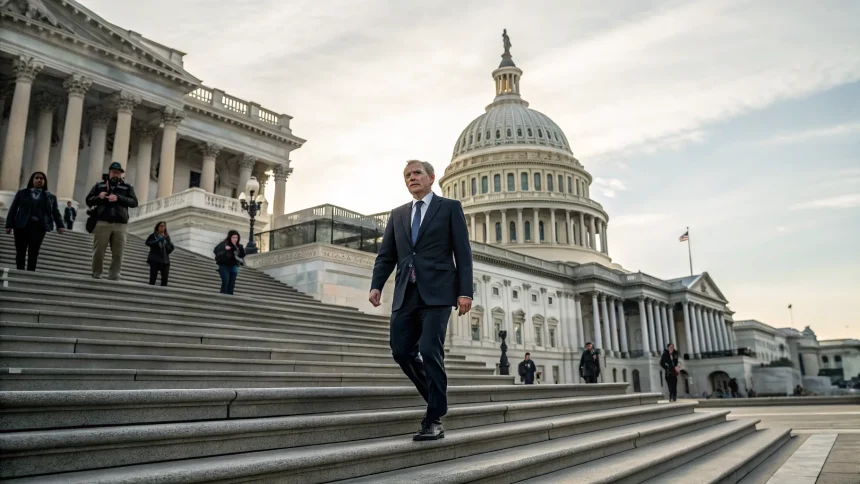
Acting Attorney General Todd Blanche is expected back on Capitol Hill after the administration paused plans for a nearly $1.8 billion fund meant to compensate allies of President Donald Trump who say they were unfairly investigated. The return visit, expected this week in Washington, sets up a tense round of oversight as lawmakers press for details on who would qualify, how claims would be judged, and why the Justice Department advanced the idea in the first place.
The pause signals concern inside the administration about the legal and political fallout. It also raises basic questions about the use of federal money to revisit past investigations involving the president’s circle.
What Sparked The Showdown
Acting Attorney General Todd Blanche is set to return to Capitol Hill after the Trump administration signaled it was pausing contentious plans to move forward with a nearly $1.8 billion fund that could compensate allies of President Donald Trump who believe they’ve been unjustly investigated.
That single sentence set off a scramble on both ends of Pennsylvania Avenue. Supporters argue the fund could give relief to people who spent years and fortunes fighting probes they see as politically driven. Critics say it risks turning federal justice into a rewards program for insiders.
Blanche’s appearance gives Congress a rare chance to press a sitting Justice Department leader on whether the plan was vetted for conflicts of interest, how the figure of $1.8 billion was reached, and whether the department consulted career officials before moving ahead.
A Fight Over Fairness And Power
At the core is a clash over fairness. One side frames the idea as overdue relief for individuals they believe were treated unfairly. The other sees a breach of the boundary between law enforcement and politics.
Legal scholars warn that paying people tied to ongoing or past cases could chill future investigations. They also question whether the executive branch can create such a program without a specific law from Congress. Any attempt to steer awards to a narrow group could draw constitutional challenges on equal protection and due process grounds.
Budget watchdogs add a simpler point: a $1.8 billion promise sets expectations the Treasury may not meet, especially without a clear method to verify harm or value claims.
The Questions Lawmakers Will Ask
- Who qualifies as an “ally,” and who decides?
- What evidence would prove an investigation was unjust?
- How would the department avoid conflicts of interest?
- Why $1.8 billion, and what is the funding source?
- Would victims of wrongful probes outside politics get equal access?
How This Compares To Other Relief Efforts
Past federal programs that paid people for harm—such as compensation for wrongful convictions or mass disasters—rested on clear eligibility rules and bipartisan laws. They also relied on independent special masters or judges, not political appointees, to review claims. By contrast, a program targeting people linked to a single political figure would face higher scrutiny to prove neutrality and fairness.
Any credible version would likely need: strict, public criteria; independent claim review; disclosure of awards; and an appeals process. Without those guardrails, the plan would struggle in court and with public opinion.
Political Fallout And The Road Ahead
The pause gives the Justice Department room to rethink. But it does not end the fight. Lawmakers from both parties want documents, timelines, and the names of officials who worked on the plan. If Blanche cannot answer those questions, expect subpoenas and a freeze on related funding.
Even a scaled-back idea could reshape how Americans view high-profile investigations. A payout system seen as favorable to one group would deepen mistrust. On the other hand, a transparent, law-based review of claims—open to anyone who can prove harm—could channel anger into a legal process rather than political theater.
For now, the safest path runs through Congress. If the department believes compensation is warranted, it can seek a statute with bright-line rules and outside oversight. That would spread the political risk, invite public debate, and reduce the chance of court defeats.
Blanche’s testimony will offer the first real test. If he can explain the pause, outline legal options, and commit to independent review, the idea may get a second look. If not, the $1.8 billion plan is likely to sit on ice—and become a rallying cry in the fights to come.