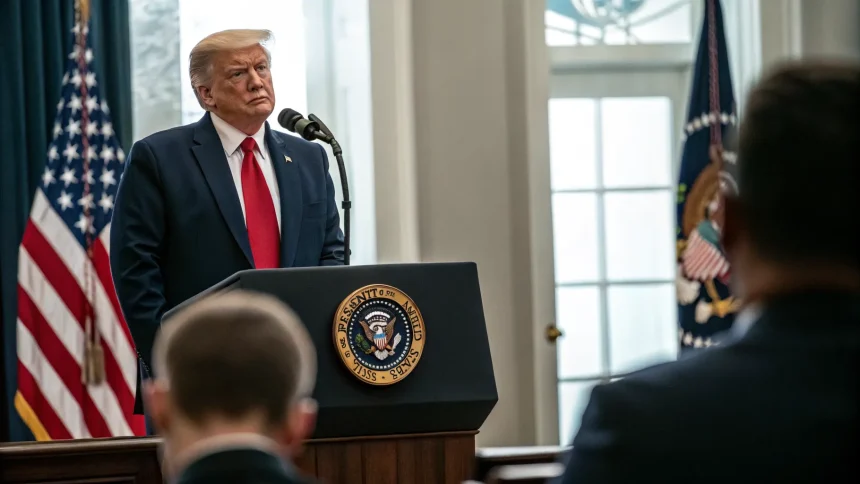
A president has criticized a prime minister for delaying approval for U.S. use of the air base on the Chagos Islands, telling the Telegraph the decision “took far too long.” The rare public rebuke, delivered in an interview, spotlights long-running tensions over access to Diego Garcia, one of the most strategically important air and naval hubs in the Indian Ocean.
The exchange centers on when and how the United States can operate from the British Indian Ocean Territory. It comes amid rising security pressures across the region and ongoing talks over the islands’ future status.
A Strategic Outpost With a Complex Past
The Chagos Islands, administered by the United Kingdom since the 1960s as the British Indian Ocean Territory, host the U.S. base at Diego Garcia under a long-term defense agreement. The arrangement, first signed in 1966 and extended in 2016, has supported operations across the Middle East, East Africa, and South Asia.
Behind the facility lies a painful history. Between the late 1960s and early 1970s, an estimated 1,500 to 2,000 Chagossians were removed from the archipelago to make way for the base. Their displacement has fueled decades of legal and political challenges. In 2019, the International Court of Justice issued a non-binding advisory opinion stating that the UK should end its administration of the islands, and the UN General Assembly urged the same. The UK has since entered talks with Mauritius about the territory’s future, while maintaining that the base’s operations remain vital to security.
The Charge of Delay
In the interview, the president did not name a specific operation but accused the prime minister of slowing a key approval. The comment suggests friction within a partnership typically handled behind closed doors.
“[The prime minister] took far too long to let America use [the] Chagos Islands air base,” the president said.
Such permissions can involve flight clearances, basing rights for particular missions, or reload and refuel authorizations. Delays may reflect legal checks, diplomatic sensitivities, or coordination with allies. But public criticism implies a belief that the holdup had operational costs.
Security Stakes in the Indian Ocean
Diego Garcia’s location gives U.S. and allied forces reach into shipping lanes and conflict zones. Recent regional strains, from threats to maritime trade to instability around the Horn of Africa, have increased the demand for reliable access and rapid response. Any slowdown in approvals can ripple through logistics and readiness.
Defenders of tighter controls argue that host nations must weigh legal duties, sovereignty issues, and ongoing negotiations over the islands’ status. They also point to scrutiny from international bodies and courts, as well as the need to address the rights of displaced communities.
Diplomacy, Law, and Human Impact
The political sensitivity is high. The UK has said that defense cooperation with the U.S. remains strong, even as it consults on the territory’s future. Mauritius has maintained its claim over the islands while signaling support for the base’s continued security role under a different sovereignty arrangement. Chagossian groups seek recognition, resettlement options, and reparations, pressing both governments to include them in decisions.
Analysts say the latest criticism could complicate delicate talks. It may also push officials to clarify rules for rapid access, especially during crises, while reaffirming commitments to international law and human rights.
What the Dispute Could Mean
- Operations: Any future delays could slow deployments or limit mission flexibility across the Indian Ocean and adjacent regions.
- Alliances: Public rifts risk signaling disunity, even if day-to-day military coordination remains close.
- Governance: Ongoing talks with Mauritius and calls from Chagossians add pressure to update the legal framework for the base.
Looking Ahead
The countries involved are likely to review approval processes to avoid repeat disputes. Clearer timelines, predefined triggers for expedited access, and transparent communication could ease friction without weakening oversight.
The broader debate will continue to tie security strategy to legal and moral questions from the islands’ past. Any agreement on sovereignty or resettlement could set terms for the base’s next chapter, including how quickly missions are cleared in periods of heightened risk.
For now, the president’s sharp remark turns a technical matter into a political test. It highlights the urgent need to balance operational speed with accountability, and to align defense planning with the unresolved future of the Chagos Islands.