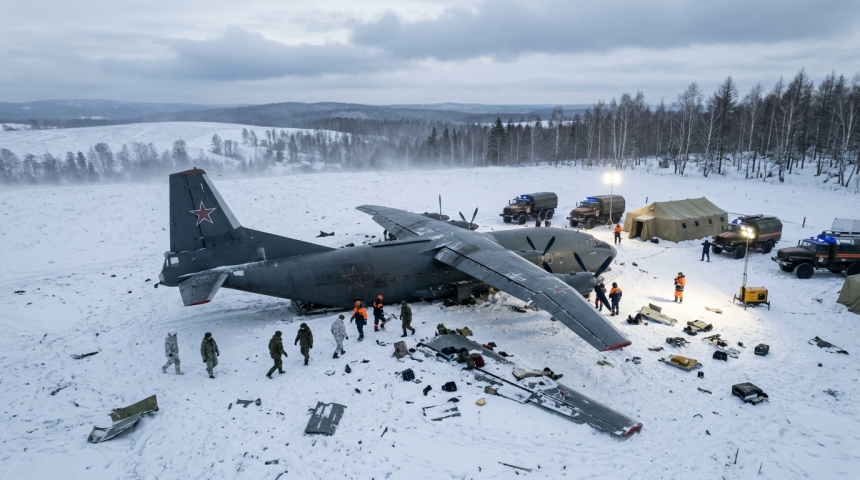
A Russian military transport aircraft crashed in southwestern Siberia, killing all 19 people aboard, according to the country’s defence ministry.
The An-12 aircraft went down in Russia’s Kemerovo region, the ministry was quoted as saying on Tuesday. The report did not identify the passengers or crew, explain the aircraft’s mission, or state what caused the crash.
The loss of everyone aboard makes the incident a major military aviation disaster. It also places fresh attention on flight safety and maintenance within Russia’s transport fleet.
Few Details Released After Crash
Initial information confirmed the aircraft type, location, and death toll. No survivors were reported among the 19 people aboard.
Several central facts were not immediately available:
- The aircraft’s departure point and destination
- The number of crew members and passengers
- Weather conditions during the flight
- Whether the pilots reported an emergency
- The location and condition of the wreckage
There was also no immediate information about a formal investigation. Military aviation inquiries often examine maintenance records, crew actions, weather, air traffic data, and possible equipment failures.
Until investigators release evidence, any conclusion about the cause would be premature. Early reports after aircraft crashes can change as authorities confirm identities and recover flight records.
An-12 Serves as a Heavy Transport
The An-12 is a four-engine turboprop aircraft designed to carry troops, equipment, and cargo. It was developed during the Soviet period and has served military and civilian operators for decades.
Its long operating history has made it a familiar aircraft across Russia and other former Soviet states. However, the continued use of older airframes can increase scrutiny of inspections, repairs, spare parts, and operating limits.
An aircraft’s age alone does not establish why it crashed. Maintenance standards, flight conditions, pilot decisions, and the condition of individual systems are also central to an investigation.
The defence ministry’s role in reporting the deaths indicates that the flight was under military authority. Military crashes can involve tighter controls on public information, especially if the aircraft carried sensitive cargo or personnel.
Kemerovo Faces Difficult Recovery Conditions
Kemerovo is a Siberian region associated with mining and heavy industry. Its large territory includes cities, forests, and areas where access may be difficult.
The exact crash site was not disclosed. Its location would affect how quickly emergency workers could reach the wreckage and recover evidence.
Investigators will likely seek aircraft records and communications while documenting how debris was spread. Those findings may help determine whether the An-12 suffered a sudden failure or remained under partial control before impact.
The immediate priority is identifying the victims and informing their families. Officials will also face pressure to explain the flight’s purpose and whether safety concerns had been reported before departure.
The confirmed toll of 19 leaves no prospect of survivor accounts, making physical evidence and recorded communications especially important. The next official updates should clarify the identities of those killed, the aircraft’s route, and the scope of the inquiry.
For Russia’s military, the findings could carry wider consequences. Evidence of maintenance or operational failures may lead to inspections of similar aircraft. Until those findings are released, the cause of the Kemerovo crash remains unknown.