The US government is seeking to speed the development of quantum computers, hoping to gain access to a useful system sooner. The effort reflects growing concern that quantum technology could shape national security, scientific research, and economic competition.
Quantum computers remain experimental and prone to errors. Yet Washington has funded research for years because these machines may eventually solve selected problems that overwhelm conventional computers.
Why Washington Wants Faster Progress
Quantum computers process information using quantum bits, known as qubits. Unlike ordinary bits, qubits can represent complex combinations of states. This may help with certain calculations, but maintaining stable qubits is difficult.
A practical machine could support research in chemistry, materials, medicine, logistics, and energy. It could also threaten some encryption methods used to protect government, financial, and personal information.
That security risk adds urgency to the US effort. A country that builds a capable quantum computer first could gain an advantage in intelligence gathering and scientific discovery.
However, quantum computers are not expected to replace conventional systems. Their likely role is narrower, focused on tasks suited to quantum methods.
Federal Support Has Expanded
The push builds on earlier federal programs. Congress approved the National Quantum Initiative Act in 2018, creating a coordinated research program across major agencies.
The Department of Energy supports national research centers and laboratory work. The National Science Foundation funds academic research and workforce programs. The National Institute of Standards and Technology develops measurement tools and security standards.
The Defense Department and intelligence agencies also have an interest in quantum computing, sensing, and communications. Their support connects scientific research with possible national security uses.
Federal policy has generally focused on several priorities:
- Improving the quality and stability of qubits.
- Developing methods to correct computing errors.
- Training scientists, engineers, and technicians.
- Moving research from laboratories into usable systems.
- Protecting sensitive technology and supply chains.
Technical Barriers Remain
Speeding research does not guarantee an early breakthrough. Qubits are highly sensitive to heat, vibration, and electromagnetic interference. Small disturbances can destroy the information needed for a calculation.
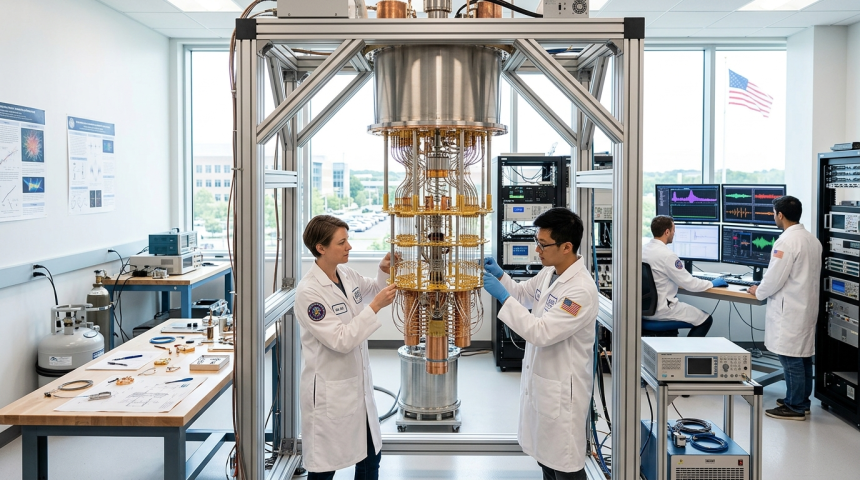
Error correction is another major challenge. Many physical qubits may be required to create one reliable logical qubit. Researchers are testing several designs, including superconducting circuits, trapped ions, neutral atoms, and light-based systems.
Each approach has benefits and limits. Government funding can support parallel research, reducing dependence on a single design. It can also help universities and national laboratories test ideas that private investors may view as too risky.
Competition and Security Shape the Race
The United States is not working alone. China, European nations, Canada, Japan, Australia, and other governments are investing in quantum research. Private companies are also building processors, software, and cloud-based research tools.
Competition may shorten development schedules, but it can create pressure to overstate results. Qubit totals alone do not show whether a machine can perform accurate, useful work. Error rates, operating time, and software performance also matter.
Cybersecurity planning is already moving ahead. US agencies have supported new encryption standards designed to resist future quantum attacks. Organizations may need years to identify vulnerable systems and replace older protections.
The government’s drive could bring more funding, research partnerships, and workforce programs. Still, useful quantum computing will depend on steady engineering gains rather than a single announcement. The key measures will be lower error rates, reliable logical qubits, and proof that quantum systems can solve valuable problems better than existing machines.