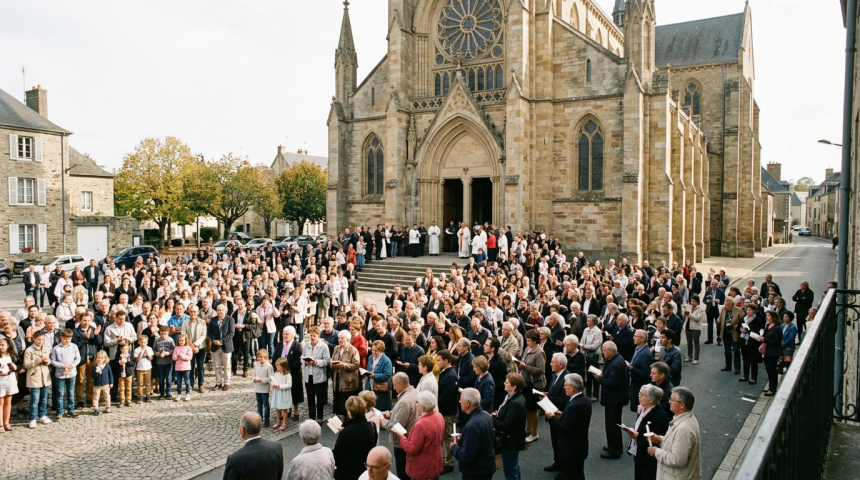
A large turnout at a church gathering in France has shown that the institution still commands public attention, despite lower attendance and wider secular change.
The event’s location, date, purpose and attendance total were not identified. That limits direct comparisons with other gatherings. Still, the crowd offered a visible contrast with the empty pews often associated with European Christianity.
Influence Extends Outside Weekly Worship
Church attendance is only one measure of religious influence. Many people who rarely attend services still enter churches for funerals, weddings, baptisms and major holidays.
Religious buildings also serve as historic sites and community spaces. They can draw large crowds after national tragedies, during public mourning or for major cultural events.
“The turnout testified to the church’s lasting influence in France despite declining attendance and secularizing trends that have emptied churches across Europe.”
The observation points to a central issue for church leaders. Institutional participation may be weakening, while cultural ties remain strong. A person may identify with Catholic traditions without accepting church teaching or attending Mass each week.
France’s Long Secular Shift
France has a distinct relationship with religion. The country’s principle of laïcité separates religious institutions from the state and seeks official neutrality in public life.
That model was shaped by centuries of tension between the Catholic Church and the French state. A 1905 law established the modern legal separation of church and state.
Recent national research shows how far religious affiliation has fallen. A 2019-2020 survey by France’s national statistics agency, Insee, found that 51% of adults aged 18 to 59 in metropolitan France reported no religion. Catholicism remained the largest declared faith, at 29%.
Those figures do not mean religion has disappeared. They show that formal identity and regular practice have changed, especially among younger generations.
- Weekly worship is less common than in earlier decades.
- Historic churches retain cultural and civic importance.
- Major ceremonies can attract people who seldom attend services.
- Public turnout does not always equal agreement with church doctrine.
A Wider European Pattern
France is part of a broader European trend. Many churches face aging congregations, fewer clergy and the high cost of maintaining old buildings.
Yet the pattern is uneven. Some parishes remain active, while migrant communities have strengthened Christian worship in certain cities. Pilgrimages and major religious festivals can also attract large numbers.
Critics may caution against reading too much into a single crowd. Attendance at one event can reflect grief, tradition, tourism, civic solidarity or interest in a public figure. It does not prove a return to regular worship.
For church leaders, however, such gatherings show that religious institutions still have access to a broad public audience. The challenge is turning occasional engagement into lasting participation, if that is their goal.
The turnout therefore reflects both continuity and change. France is more secular than it was in past generations, but churches still carry historical, social and symbolic weight. Future attendance data, membership trends and participation among younger people will show whether that influence endures or continues to narrow.