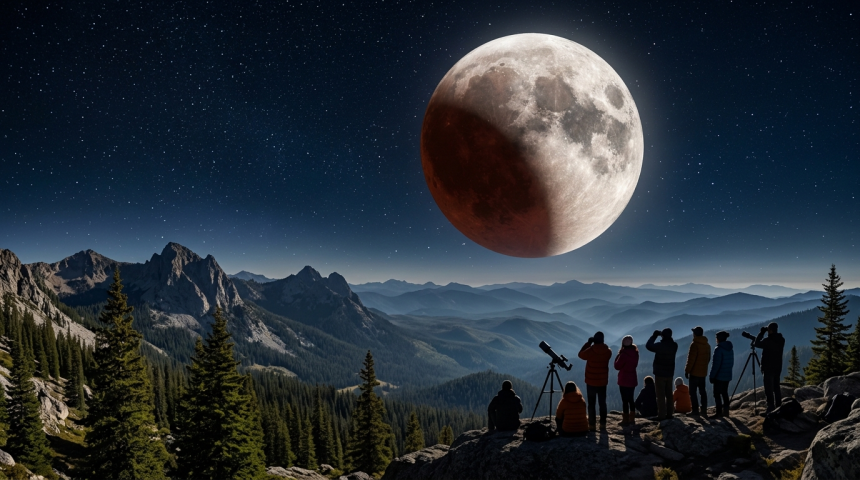
Skywatchers across North America watched the moon darken overnight during a striking partial lunar eclipse, often called a “blood moon.” The event offered viewers a visible lesson in orbital motion, with Earth briefly casting its shadow across part of the lunar surface.
The eclipse could be seen without special protective equipment. Unlike a solar eclipse, a lunar eclipse is safe to view directly. Clear skies and an open view of the moon were the main requirements.
Why the Moon Changed Color
A lunar eclipse occurs when Earth moves between the sun and the moon. The three bodies must line up closely enough for Earth’s shadow to fall on the moon.
During a partial eclipse, only part of the moon enters Earth’s darkest central shadow, known as the umbra. That creates a curved dark area that appears to move across the lunar surface.
The reddish color comes from sunlight passing through Earth’s atmosphere. Blue light scatters more easily, while red and orange wavelengths continue through the atmosphere and reach the moon.
Viewers across North America “marveled overnight as the moon dimmed” during the partial eclipse.
The nickname blood moon is more commonly linked to a total lunar eclipse, when the whole moon enters the umbra. Still, the phrase is often used more loosely when a partial eclipse produces a copper or rusty shade.
A Shared Event Across a Continent
Lunar eclipses can be visible across a wide geographic area because anyone on Earth’s night side may have a chance to see them. That differs from total solar eclipses, whose full effect follows a narrow path.
Visibility still depends on several practical factors:
- Cloud cover can hide some or all of the eclipse.
- Buildings and trees may block views near the horizon.
- Local timing determines how high the moon appears.
Light pollution is less troublesome for lunar viewing than for meteor showers or faint stars. The moon remains bright enough to observe from many cities, though darker locations can provide greater contrast.
Why Eclipses Do Not Happen Monthly
A full moon occurs about once each month, but lunar eclipses are less frequent. The moon’s orbit is tilted relative to Earth’s path around the sun. Most months, the moon passes slightly above or below Earth’s shadow.
An eclipse happens only when a full moon passes near one of the points where those orbital paths cross. Astronomers can calculate these alignments far in advance, making eclipses among the most predictable sights in the night sky.
The overnight display gave North American viewers a free and accessible astronomy event. Its scientific cause was routine, but its appearance was anything but ordinary. Future lunar eclipses will bring similar opportunities, with weather and location deciding who gets the clearest seat.