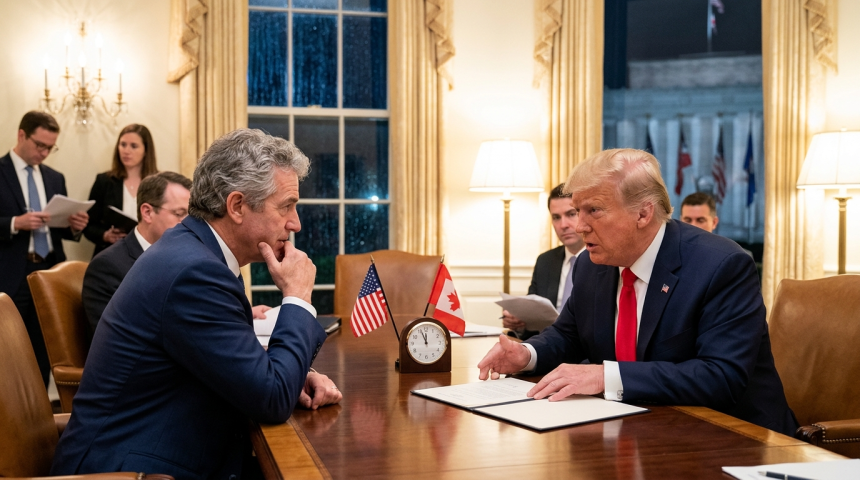
President Donald Trump delayed planned 50% U.S. tariffs on Canadian imports after the two countries reached a last-minute agreement. The decision came less than two hours before the measures were scheduled to take effect.
The reprieve prevented an immediate increase in import costs and eased the threat of a new trade conflict between close economic partners. However, the limited details available leave major questions about the agreement and its duration.
Last-Minute Deal Prevents Tariff Increase
Trump announced the delay after negotiations produced an agreement shortly before the deadline. The timing suggests both governments faced strong pressure to prevent the tariffs from taking effect.
A 50% tariff would add a substantial charge to affected Canadian goods entering the United States. Importers generally pay tariffs at the border. They may absorb the cost, seek lower prices from suppliers, or pass part of it to customers.
The announcement described a delay rather than a permanent withdrawal. That distinction matters because businesses may still face uncertainty if the tariff threat remains active.
- The proposed U.S. tariff rate was 50%.
- The measures targeted imports from Canada.
- An agreement was reached less than two hours before implementation.
- The announced action delayed the tariffs.
Businesses Avoid Immediate Disruption
The delay gives importers, exporters and manufacturers more time to plan. Companies exposed to cross-border trade had faced the prospect of sudden cost increases and possible supply disruptions.
Canada and the United States have closely linked production and distribution networks. Goods and materials can cross the border during several stages of manufacturing. A large tariff can therefore affect more than the original importer.
The immediate benefit is greater short-term price stability. Businesses will not need to apply the planned 50% charge under the original schedule. Consumers may also avoid near-term price increases tied to the measure.
Still, a delay does not offer the same certainty as cancellation. Companies may remain cautious about orders, contracts and investment until both governments explain the terms.
Key Terms Remain Unclear
The announcement did not provide the length of the delay or identify any conditions attached to it. It also did not specify which Canadian products would have faced the tariff.
Those details will determine the agreement’s economic importance. A short pause tied to further talks would offer only temporary relief. A longer suspension could give companies more confidence to proceed with cross-border plans.
Another issue is whether either government made policy commitments to secure the delay. Without that information, it is difficult to assess the costs and benefits for each country.
Tariff Threat Retains Negotiating Force
The episode shows how tariff deadlines can be used as negotiating pressure. The threat of a steep charge created urgency and produced an agreement shortly before implementation.
Supporters of that strategy may view the deal as evidence that economic pressure can secure rapid concessions. Critics may argue that sudden deadlines create market uncertainty, even when tariffs are postponed.
For now, the agreement has prevented an immediate trade shock. The next test will be whether the delay leads to a lasting settlement or another deadline. Businesses and consumers will be watching for the timetable, covered products and conditions that could revive the 50% tariffs.