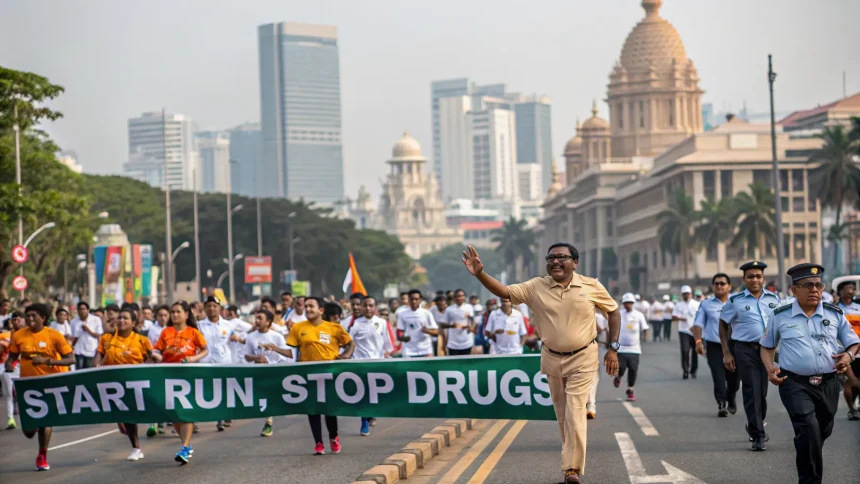
Chief Minister Vijay flagged off the Start Run, Stop Drugs anti-drug awareness marathon in Chennai this week, signaling a high-profile push to curb substance abuse across Tamil Nadu. The citywide run brought together students, athletes, civil society groups, and police officers to raise awareness and encourage prevention. The launch in the state capital framed the effort as both a public health drive and a community safety measure.
The event aimed to reach young people and families with a clear message: prevention starts with education and support. Organizers placed the marathon in a broader plan that mixes outreach, treatment access, and strong enforcement. The effort reflects concerns about drug use among adolescents and the spread of synthetic substances in urban and semi-urban areas.
“Start Run, Stop Drugs.”
Background: Why A Public Run Now
Anti-drug campaigns in India often rely on school talks, helplines, and police raids. Marathons add a public, visible element that is hard to ignore. Tamil Nadu has held awareness drives in schools and colleges for years, but officials say large community events can reach people who do not attend formal sessions.
Public health experts warn that early use of substances increases the risk of long-term harm. Families report challenges in spotting early signs and finding help. A mass event can connect households to information in a friendly setting. It also shows government agencies working together with volunteer groups.
Chennai was chosen for its size and reach. Messages that start in the capital tend to spread quickly to district towns through colleges, sports clubs, and local media.
Inside The Campaign: What It Tries To Do
The marathon’s goals are simple and action-focused. Organizers highlighted prevention, early help, and community watch. They urged schools and sports clubs to run follow-up sessions in the next few weeks.
- Promote awareness of early warning signs among teens.
- Link families to counseling and treatment options.
- Encourage safe reporting of peddling near schools and transit hubs.
- Build healthy routines through sport and peer support.
Police representatives emphasized that enforcement alone cannot solve the problem. Health workers, in turn, said stigma keeps people from seeking help. The campaign attempts to close that gap by placing both messages on the same stage.
Multiple Viewpoints On What Works
School leaders welcome easy-to-use materials that they can share during assemblies and parent meetings. Coaches say structured sports keep teens busy during high-risk hours after school. Community workers stress the need for culturally sensitive outreach, especially in neighborhoods with migrant labor.
Some civil society voices caution that one-day events fade without local follow-up. They call for steady funding for addiction counseling, more trained staff in district hospitals, and safe referral pathways for students. They also ask for clear guardrails to prevent over-policing that could scare families away from help.
Officials describe the run as a start of a series, not a one-off. They point to plans for campus talks, peer mentor programs, and more visible helpline numbers at bus stations and train terminals.
Signals From Enforcement And Health Services
Law enforcement has focused on street-level peddling near schools and transport nodes. They also report coordination with cyber units to track online sales channels. Health services say they are expanding brief intervention sessions at primary health centers to catch cases early.
Experts argue that the most effective model pairs quick enforcement with ready access to care. If a family can reach a counselor within days, relapse risk drops. If a user faces only punishment, avoidance rises and harm grows. The Chennai event tried to make that trade-off clear to the public.
What To Watch Next
The real test will be what follows in the next 90 days. Schools will need toolkits, not just slogans. District hospitals must track wait times for first appointments. Police will be judged on both seizures and community trust.
Organizers say they will measure progress through attendance at follow-up sessions, calls to helplines, and referrals made by school counselors. Public reporting of these numbers can build trust and guide changes.
The Chennai launch sent a message of shared duty. It set a tone of prevention, early help, and fair enforcement. If the promise of the Start Run, Stop Drugs campaign is matched by steady work on the ground, Tamil Nadu could see safer campuses and stronger support for families seeking help.