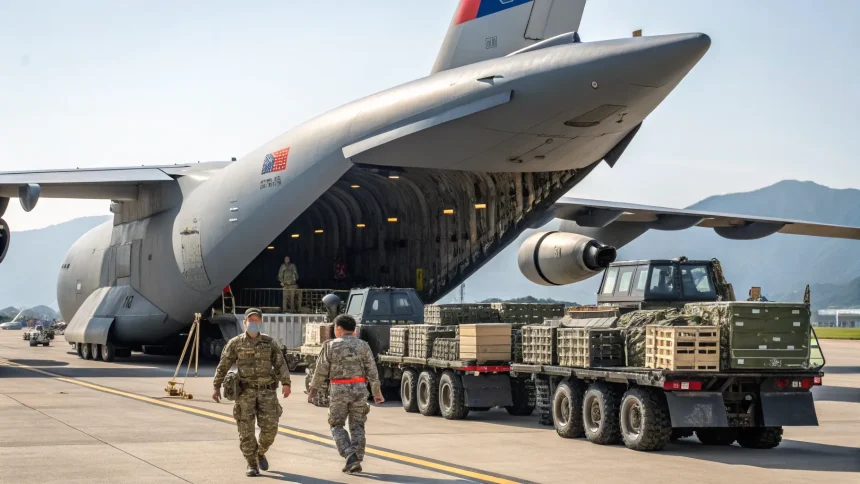
Taiwan’s government said it has received no notice of a halt to a planned $14 billion U.S. arms package, pushing back against reports of a potential delay. The statement, issued Monday in Taipei, comes as Taiwan tracks deliveries long promised by Washington and as tensions with China remain high across the Taiwan Strait.
The clarification matters because the island relies on U.S. weapons to modernize its defenses and deter coercion. Any pause would raise new questions about delivery timelines, industry capacity, and regional security.
Official Statement and Immediate Reaction
“Taiwan’s government says it hasn’t been notified of any pause in a planned $14 billion U.S. arms sale to the self-governing island.”
Officials in Taipei framed the message as routine procedure: unless Washington issues a formal notice, procurement plans remain on track. They did not name the specific systems covered by the package in this statement, but stressed that coordination with U.S. counterparts is ongoing.
Analysts said the move aims to calm markets and the public amid swirling rumors. It also signals to Washington that Taipei expects agreed deals to proceed on schedule.
Background: A Long Queue of Deliveries
Arms transfers to Taiwan are governed by the U.S. Taiwan Relations Act, which supports the island’s self-defense. In recent years, U.S. administrations have approved multiple sales, covering air defense, anti-ship missiles, and munitions. Production and shipping have, at times, lagged behind approvals.
Defense industry watchers point to global demand as a key factor. U.S. manufacturers are balancing orders linked to the war in Ukraine and commitments in the Middle East, alongside long-term Pacific priorities. This has stretched production lines and delivery schedules.
China opposes U.S. sales to Taiwan and often issues protests, calling them a violation of its “One China” principle. Washington argues that the sales are consistent with its long-standing policy and needed for stability.
What $14 Billion Means for Taiwan’s Defense
The reported $14 billion package would represent a major slice of Taiwan’s multi-year procurement plan. While details are not confirmed in the latest statement, recent orders have focused on asymmetric systems designed to raise the cost of any attack, including mobile missiles, drones, and air defense interceptors.
Experts say timely delivery is vital for training pipelines, spare parts, and operational readiness. A pause—even a short one—could ripple through force planning and exercises.
Regional Security and Beijing’s Likely Response
China has stepped up military flights and naval patrols near the island over the past three years. Each new U.S. sale often draws a sharp response from Beijing, including sanctions on defense firms and military drills. Taipei argues that steady deliveries reduce the chance of miscalculation.
Some scholars caution that spikes in military activity can follow major announcements. They advise careful public messaging to prevent misreading of intent on both sides.
Industry Capacity and Policy Signals
U.S. defense companies face labor, supply chain, and tooling constraints. Even when approvals are fast, assembly and testing can add months. Policy experts say clear schedules and multi-year contracts help factories invest in output increases.
- Demand for air defense munitions has surged since 2022.
- Dual-use components, like microelectronics, remain tight in supply.
- Training and sustainment often trail hardware by months.
Congressional oversight also plays a role. Lawmakers have pressed the Pentagon to reduce the delivery backlog and to prioritize Indo-Pacific commitments. A formal pause notice, if it existed, would likely draw immediate scrutiny on Capitol Hill.
What to Watch Next
Without an official notice from Washington, Taipei is signaling business as usual. Still, questions remain about the delivery calendar and whether specific systems could face slippage. Any update from U.S. defense officials or contractors will be closely watched in Taipei and Beijing.
For now, the takeaway is clear: Taiwan says no pause has been communicated, and planning continues. The next indicators will be factory output, shipping schedules, and regional military activity. If deliveries align with plans, Taiwan’s defense posture strengthens. If delays stack up, pressure will build for new timelines and interim fixes.
The coming weeks should clarify whether this $14 billion package stays on track, and how both Washington and Taipei manage expectations amid tight global supply and rising security risks.