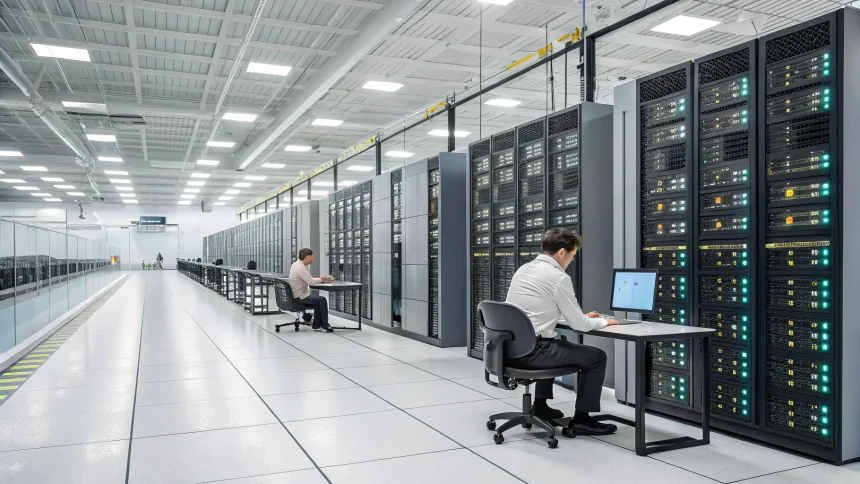
At a developer conference in San Francisco, Anthropic CEO Dario Amodei said the company is “working as quickly as possible” to provide additional compute, signaling fresh urgency in the race to power larger and more capable AI models. The comment, delivered to a room of developers, highlights an industry-wide bottleneck: access to the servers and specialized chips required to train and run advanced systems.
The push comes as demand for Anthropic’s Claude models grows across startups and enterprises. Developers continue to press for faster responses, larger context windows, and more reliable uptime. Amodei’s remarks suggest the company sees scaling infrastructure as essential to meeting that demand and competing at the top tier of AI research and deployment.
Why Compute Capacity Matters Now
AI companies rely on clusters of GPUs and other accelerators to train and serve models. Over the last two years, a shortage of high-end chips has slowed rollouts and raised costs across the field. For developers, that often shows up as rate limits, model waitlists, or sudden pricing changes.
Anthropic has expanded rapidly as Claude gained traction with coders, customer support teams, and knowledge workers. But each new feature—larger context windows, more tools, better reasoning—demands more processing power in the background. Amodei’s signal that the company is moving quickly suggests the next phase of product updates will hinge on securing and deploying new capacity.
“[We are] working as quickly as possible to provide additional compute.” — Dario Amodei, CEO of Anthropic
Background: A Tight Market for Chips
The entire sector faces a squeeze. High-performance GPUs remain in short supply, and delivery timelines for new hardware stretch months. That crunch has pushed AI labs to diversify their suppliers and deepen cloud partnerships.
Anthropic has leaned on major cloud providers to scale training and inference. This approach helps spread risk and speeds up deployment, but it also ties service availability to complex supply chains and data center buildouts.
- Global demand for AI accelerators has outpaced supply for multiple upgrade cycles.
- Cloud regions capable of hosting large clusters are limited and often booked in advance.
- Long-lead hardware orders can collide with fast product roadmaps.
What More Compute Could Unlock
Developers often push models to the edge of their limits, stitching together tools and prompts to handle dense documents, code, and multimedia. Additional compute can translate into higher throughput, larger input sizes, and improved reliability during peak hours.
Enterprises want consistent latency and strong data isolation. That often requires regional capacity and dedicated resources. A larger compute footprint could make it easier for Anthropic to offer better service-level guarantees and specialized configurations for regulated industries.
More capacity also supports research. Bigger training runs and longer fine-tuning cycles can produce models that are more capable and safer. That matters as customers test AI in customer service, legal review, and software development.
Developer Impact and Trade-Offs
For developers, the immediate questions are access and price. Expanded capacity can reduce throttling and improve availability. But higher infrastructure costs sometimes pass through to usage rates, especially for premium tiers or new features.
Teams building on top of Anthropic will watch for clearer guidance on quotas, region support, and model version timelines. Many also want visibility into reliability goals and migration paths as infrastructure changes roll out.
Safety, Reliability, and Market Competition
As compute scales, safety guardrails remain a central topic. Anthropic has emphasized model behavior testing and risk reduction. More infrastructure can help by enabling broader evaluation before release. It can also support red-teaming and monitoring tools that run alongside production models.
Competition is intense, with multiple labs chasing the same chips and data center slots. Access to reliable compute has become a strategic edge. Vendors that secure capacity can launch features faster and win enterprise deals that demand performance at scale.
What to Watch Next
Amodei’s message suggests near-term moves to add servers and expand regions. Signals to monitor include new cloud partnerships, commitments for next-generation accelerators, and announcements tied to model upgrades.
Developers may also see staged rollouts: capacity increases targeted at high-demand features first, followed by broader availability. Clear communication on limits and timelines will be key to keeping teams on schedule.
The bottom line is simple: performance and reliability depend on compute. As Anthropic races to expand capacity, the outcome will shape how quickly developers can build and how far enterprises can scale AI across their workflows. The next few quarters will show whether new infrastructure can keep up with rising demand—and whether the company can turn that momentum into faster, steadier service for users.