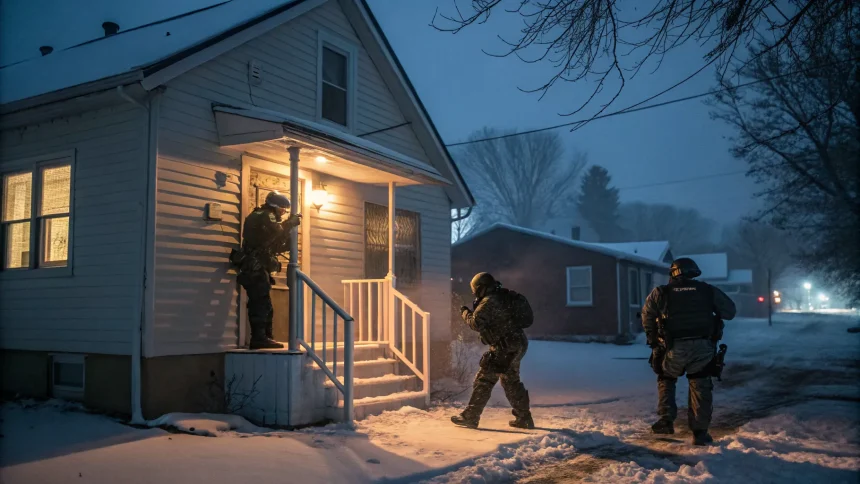
In January, a pre-dawn encounter between federal immigration officers and a resident identified as ChongLy Thao has sparked new scrutiny of home raids and warrant rules. According to Thao, officers forced their way inside without a warrant and marched him outside in freezing weather wearing only underwear and a blanket. The incident, which took place at his home, has renewed debate over how Immigration and Customs Enforcement (ICE) conducts at-home arrests and what protections apply at the front door.
The account arrives at a time when questions about searches, consent, and the limits of administrative warrants are drawing wider attention. The event centers on whether agents may enter a private residence without a judge-signed warrant and what standards should guide the treatment of people during enforcement actions.
The January Encounter
Thao describes a sudden entry and a rapid march into the cold. He says the officers acted at gunpoint and offered no judicial warrant before taking him outside. His words capture the urgency and fear of the moment.
In January, ICE officers bashed open the door of ChongLy Thao’s home at gunpoint without a warrant, then led him outside in just his underwear and a blanket in freezing conditions.
Advocates say treatment during arrests can affect health and safety, especially in winter conditions. They argue that basic steps—such as allowing a person to dress—should be routine unless there is a clear safety risk.
What the Law Says About Home Entries
The Fourth Amendment protects against unreasonable searches and seizures, and courts have long treated the home as a place with the highest expectation of privacy. Law enforcement officers generally need a judicial warrant to enter a private home to make an arrest, unless a resident consents or an emergency leaves no time to obtain one.
ICE often relies on administrative warrants signed by agency officials, which do not authorize entry into a private dwelling without consent. Lawyers point to this gap as a source of frequent disputes during door-to-door operations. If officers force entry without a judge’s warrant or valid consent, any arrest may face legal challenge, and evidence could be contested in court.
Emergency exceptions exist, such as when there is an immediate threat to life or the risk of escape that cannot be addressed by other means. Whether those conditions applied in Thao’s case is unclear from the account provided.
ICE Policy and the Government’s View
ICE has long argued that its enforcement focuses on public safety priorities and that officers receive training on constitutional limits, use of force, and professional conduct. The agency maintains that its personnel may carry firearms and enter premises to effectuate arrests when legally justified. Officials also say that detainee care, including access to clothing and protection from the elements, is part of standard practice.
Supporters of enforcement stress that some individuals subject to arrest may pose risks, and split-second decisions can be necessary. They note that operations can involve unknown threats inside a home. Those concerns often drive tactics such as early-morning arrests and securing the scene quickly.
Rights, Risks, and Community Response
Civil rights groups and immigration attorneys describe at-home encounters as a flashpoint for confusion. They urge clear rules at the door and consistent documentation of any consent to enter. Community organizations also call for data on how often home entries occur without judicial warrants, how force is used, and how people are treated during removal operations.
- Advocates argue that consent should be explicit and recorded when possible.
- Medical and safety protocols during arrests, including weather-appropriate clothing, remain a key concern.
Public defenders and legal aid clinics often review cases like Thao’s for potential constitutional claims. Even when immigration cases proceed in civil courts, alleged rights violations during arrests can lead to suppression issues or separate complaints.
What Comes Next
The account of the January raid will likely prompt calls for fact-finding to determine whether a judicial warrant existed, whether consent was obtained, and what safety steps were taken. If disputes remain, formal complaints or legal filings could follow, adding to a growing body of cases testing the limits of home entries in civil enforcement.
For lawmakers and local officials, the case renews attention on door policies, body-camera adoption in federal operations, and standards for care during arrests. For ICE, it raises pressure to detail when and how officers may enter private homes and what documentation they must provide.
As winter gives way to another enforcement cycle, the questions are clear: what proof must officers show at the door, what treatment is required once a person is in custody, and how should lines between safety and rights be drawn? The answers will shape trust, policy, and future operations.