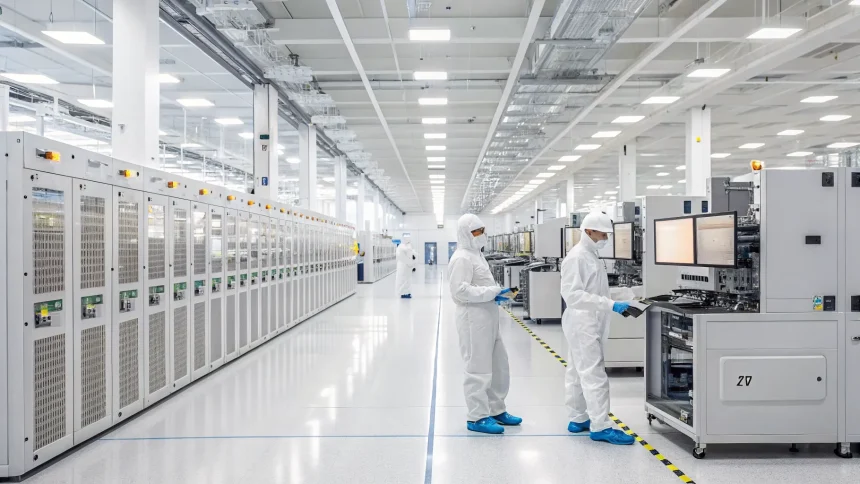
Amkor Technologies is drawing fresh interest from investors as artificial intelligence spending surges across data centers, with analysts framing the chip packager as a practical way to ride the trend. The company, a major provider of outsourced semiconductor assembly and test, stands to gain as cloud giants race to build and deploy advanced processors that require complex packaging.
The latest view comes as capital spending by hyperscalers accelerates to meet demand for generative AI and high-performance computing. Much of that investment ultimately relies on back-end work such as advanced packaging, where Amkor has scale, long-standing customer ties, and a growing U.S. footprint.
“Amkor Technologies is a derivative play on artificial intelligence amid the data center boom, analysts say.”
Why Packaging Matters in the AI Supply Chain
AI servers run on high-end accelerators and CPUs that push power, memory, and interconnect limits. Getting those chips to perform at scale requires advanced packaging methods like flip-chip, 2.5D, and 3D stacking. These steps connect processors to high-bandwidth memory and sophisticated substrates, which help move data faster and manage heat.
Amkor’s role sits after wafer fabrication but before system assembly. The company helps turn bare silicon into working parts through packaging and test. As AI models grow, so does the demand for high-bandwidth memory and chiplet-based designs, increasing the need for specialized assembly capacity.
A Business Built for Cycles—and Spikes
Founded in 1968, Amkor is one of the world’s largest outsourced semiconductor assembly and test providers. It serves a range of end markets, including computing, mobile, automotive, and industrial. The AI buildout is now adding a new leg of demand on top of cyclical recovery in smartphones and auto electronics.
The company announced plans in 2023 to build an advanced packaging and test facility in Peoria, Arizona. The project aims to strengthen domestic chip supply chains and support large U.S.-based customers. It also aligns with policymakers’ push to expand semiconductor manufacturing and assembly in North America.
What Analysts Are Watching
Analysts say the data center arms race could favor companies that can scale packaging output and manage complex product ramps. Capacity for high-end substrates and interposers remains tight across the industry, which can shift orders to partners with available lines and engineering depth. Amkor’s global footprint and ties to leading chip designers and device makers may help capture overflow demand.
They also point to rising content per server. Each AI node often includes multiple accelerators paired with stacks of high-bandwidth memory, increasing assembly steps and test time per unit. That mix tends to lift revenue per device for packaging firms.
- AI servers require advanced packaging and testing steps.
- Tight substrate and interposer supply may steer work to scaled providers.
- Higher content per server can raise revenue per packaged device.
Risks and Constraints
While the AI surge is strong, the industry remains cyclical. A slowdown in enterprise spending or a moderation in AI model rollouts could temper orders. Customer concentration is another factor, as large accounts can shift volumes or change designs quickly.
Supply bottlenecks in substrates, interposers, or high-bandwidth memory could delay shipments and affect utilization rates. Competition from other outsourced assembly and test firms, as well as in-house packaging at integrated device makers, may limit pricing power.
Signals to Track in the Months Ahead
Investors are watching data center capital expenditure forecasts from major cloud providers and chipmakers’ guidance on accelerator and CPU shipments. Announcements about new packaging nodes, substrate expansions, and 2.5D/3D capacity are also in focus. Any updates on Amkor’s Arizona facility timeline could indicate how quickly the company can add U.S. capacity for advanced work.
Market watchers are also looking for evidence that AI demand is spilling into adjacent markets. Automotive, industrial AI, and edge computing could extend the cycle if they adopt similar high-bandwidth designs.
Outlook
Amkor sits at a critical junction in the chip supply chain as AI systems scale. Its exposure to advanced packaging, broad customer set, and planned U.S. build-out position it to share in data center growth. Execution on capacity additions and supply coordination will be key.
The near-term picture hinges on hyperscaler spending, memory availability, and the pace of accelerator launches. Longer term, packaging complexity appears set to rise as chiplets and 3D integration spread. For now, analysts see Amkor as a practical way to participate in AI infrastructure demand without owning the headline chip designers.
If AI server orders stay strong and supply snarls ease, Amkor could see sustained utilization and pricing support. Watch for updates on advanced packaging capacity, customer mix, and progress in Arizona as signals of how much the AI boom reaches the back end of the chip industry.