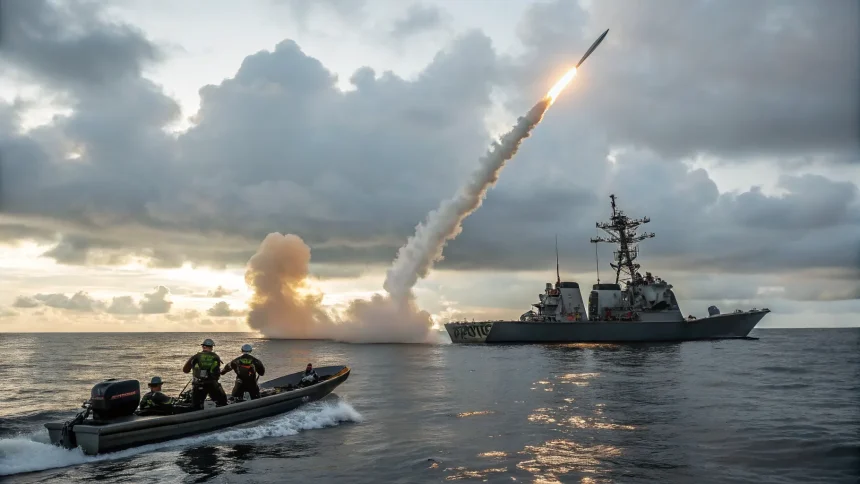
The U.S. military said it launched a strike on a boat in the Caribbean Sea that it accused of drug smuggling, leaving four people dead. The brief statement, which offered no details on timing, location, or the unit involved, signals a sharp use of force in a region where interdictions are usually handled by law enforcement and partner navies.
The announcement raises questions over legal authority, targeting procedures, and whether the crew received warnings before the strike. It also points to growing pressure on smuggling networks that move cocaine and other narcotics north through Caribbean routes.
What Happened
“The U.S. military said it carried out a strike on a boat accused of smuggling drugs in the Caribbean Sea, killing four people.”
The statement did not identify the flag of the vessel, the nationality of those killed, or whether drugs were recovered. It also did not say which service conducted the operation or whether partner forces were involved.
Legal Authority and Tactics
Maritime drug interdiction often involves the U.S. Coast Guard, working with the Department of Defense for detection and monitoring. Lethal force at sea is rare and typically follows clear rules on warning, disabling fire, and last-resort actions if a vessel poses an immediate threat or refuses to stop.
Without further detail, it is not clear whether this strike followed those steps, or whether the military acted under existing counter-narcotics authorities that allow support to law enforcement and partner nations. The use of a “strike” suggests air or ship-launched weapons rather than a boarding operation.
Why the Caribbean Matters
The Caribbean remains a key corridor for cocaine shipments from South America. Smugglers use high-speed “go-fast” boats and low-profile vessels designed to ride low on the water and avoid radar. Weather, distance, and limited patrol assets make the region hard to police, even with international cooperation.
In recent years, seizures in the Caribbean have fluctuated as traffickers shift routes to avoid patrols. Interdictions often involve multiple agencies and countries sharing radar, aircraft, and ship time to shadow suspect boats before making a stop.
Civilian Risk and Accountability
When lethal force is used at sea, investigators typically assess whether warnings were issued, whether non-lethal steps were tried, and whether the target posed a danger. Those reviews also look at identification methods, such as visual confirmation, intelligence cues, and behavior consistent with drug runs.
Human rights advocates have long warned that using military force in interdictions can increase the risk to civilian crews, including coerced couriers. Families and consulates often struggle to confirm casualties or learn where remains are held after maritime incidents.
Key Unknowns
- Which U.S. service conducted the strike and under what command.
- Whether partner forces took part or observed the action.
- If the crew received radio warnings or disabling fire before the strike.
- What narcotics, if any, were seized from the scene.
- The flag state of the vessel and the nationality of the dead.
Regional Impact
A high-profile strike could push smugglers to adjust again, using longer routes, different launch points, or decoy boats. It could also prompt diplomatic discussions if the vessel or crew came from a country in the region, especially if evidence is contested.
For coastal communities, more aggressive interdiction can reduce trafficking traffic but may also shift risks, including more nighttime chases, scuttled boats near shore, and humanitarian needs when crews abandon vessels.
What to Watch Next
Officials may release imagery, seized cargo details, or a fuller timeline in the coming days. Any mention of warning shots, radio hails, or recovered evidence will be key to understanding the decision to strike. Statements from Caribbean governments could clarify whether the operation occurred in international waters or within a nation’s maritime zone.
If confirmed as a military-led action under counter-narcotics authorities, the case may shape future coordination between the U.S. military and the Coast Guard. It may also drive calls for clearer reporting on the use of force during maritime interdictions.
For now, four deaths mark a hard turn in a fight that usually plays out with seizures and arrests. The unanswered questions—about process, proof, and proportionality—will determine whether this incident is seen as a rare edge case or a sign of sharper tactics at sea.