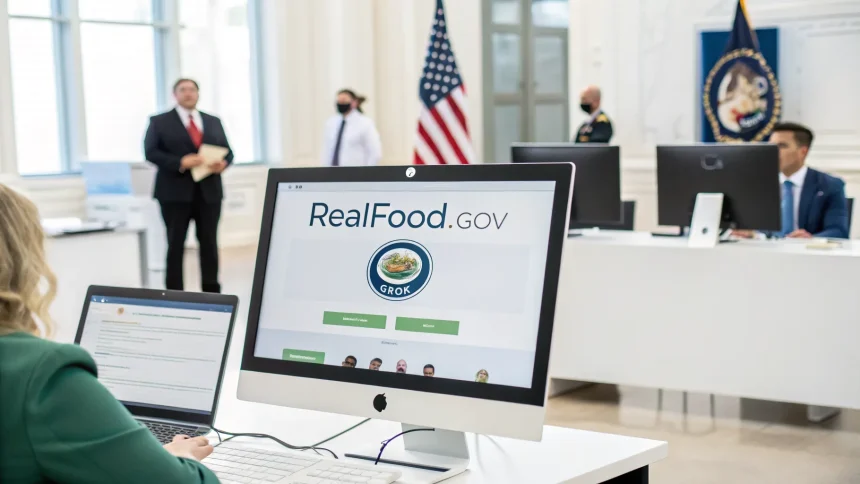
A federal website called Realfood.gov is using Elon Musk’s Grok chatbot to answer questions about diet and wellness, even as some of its guidance clashes with the government’s new nutrition rules. The move raises questions about accuracy, accountability, and the role of private artificial intelligence tools in public health messaging.
The site presents itself as a public resource, offering quick answers on food choices and healthy eating. It does so while the federal government updates its recommendations for what Americans should eat and drink. That timing has sharpened attention on how nutrition advice is sourced and presented on official platforms.
The site Realfood.gov uses Elon Musk’s Grok chatbot to dispense nutrition information—some of which contradicts the government’s new guidelines.
How AI Ended Up on a Government Nutrition Site
Public agencies have experimented with chat tools to speed up customer service and simplify complex topics. AI assistants can summarize long documents, explain terms, and tailor answers to a user’s question. The attraction is clear: faster responses and plain-language explanations for busy readers.
Nutrition is a high-stakes topic. Federal dietary guidance shapes school lunches, food labeling, and advice to doctors and patients. It also influences what families put on the table. When a .gov site hosts an AI that departs from official advice, it can blur the line between authoritative guidance and general commentary.
Points of Conflict and Why They Matter
The core concern is simple: some chatbot answers do not match the new federal guidelines. Even small gaps can have real effects. People may change habits based on a quick chat reply they assume is official.
- Trust in .gov domains: Users often treat government sites as definitive.
- Source transparency: Chatbots may not clearly cite where a claim comes from.
- Consistency of advice: Shifts in wording can create confusion about best practices.
Nutrition advice can hinge on exact numbers, such as limits on sodium or added sugars, or on patterns like favoring whole grains and vegetables. If a chatbot suggests a different limit or frames a food as “healthy” without context, users might misunderstand key trade-offs.
Supporters See Speed; Critics See Risk
Supporters of AI tools argue that conversational systems can make public health information more approachable. They see value in helping users ask follow-up questions, rather than scanning long PDFs.
Critics warn that large models can produce confident but shaky answers. They stress that medical and nutrition information must be held to a higher bar. If answers deviate from the government’s own rules on a government-branded site, accountability becomes unclear.
Experts have long urged clear guardrails for AI in health contexts. These include human review for sensitive topics, strict sourcing, and visible disclaimers when material is advisory rather than official. Consistency checks against published guidelines can reduce errors but require ongoing maintenance.
The Stakes for Public Health Communication
Americans face high rates of diet-related disease. Clear, consistent messaging helps people make better choices and reduces mixed signals. Conflicting advice from a public site could discourage trust and slow progress on nutrition goals.
The use of a private chatbot on a government domain also raises policy questions. Agencies will need to decide how third-party tools fit within federal standards for accuracy, privacy, and accessibility. They may also need to explain how data from user interactions is stored and used.
What Needs Clarifying
Key issues to watch include how Realfood.gov vets chatbot answers against the new guidelines, whether the site labels AI-generated content, and how users can view the sources behind a claim. Clear notices, consistent citations, and pathways to official documents can help close gaps.
If the chatbot continues to provide guidance, regular audits and a prompt update cycle will be important. A simple rule set—such as deferring to the published guidelines when conflicts arise—could reduce mixed messages.
For users, a few steps can help:
- Check AI answers against the official dietary guidelines.
- Look for source links or references before changing habits.
- Consult a licensed clinician for personal medical advice.
Realfood.gov’s use of Grok shows how fast AI is moving into public services. It also shows how easy it is for guidance to drift from official standards. The next steps are likely to focus on tighter oversight, clearer labels, and closer alignment with the updated rules. That will decide whether AI becomes a helpful guide on public sites—or a fresh source of confusion.