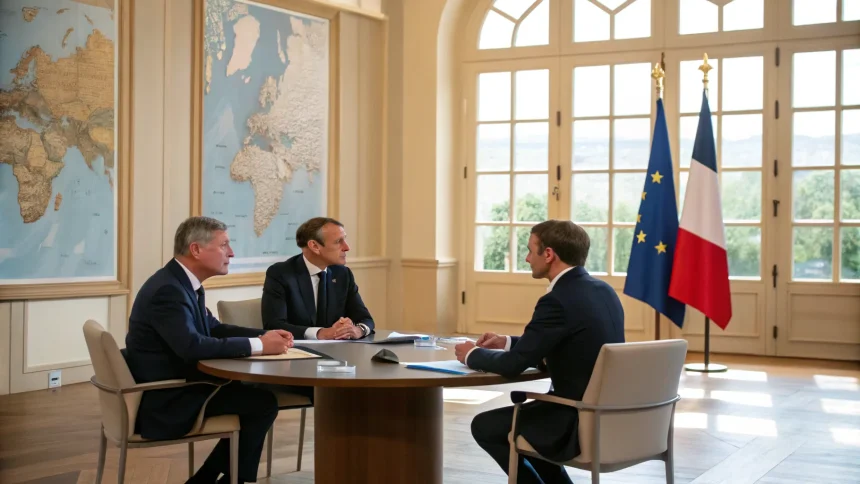
European leaders are under pressure to update their foreign policy playbooks as power moves toward a more multipolar world. The claim touches three major figures: UK Prime Minister Keir Starmer, French President Emmanuel Macron, and German opposition leader Friedrich Merz. The charge is that their strategies are tied too tightly to past assumptions about the United States, China, and the influence of the Global South. The stakes are high for security, trade, and growth across Europe.
“Starmer, Macron and Merz have gravely miscalculated by being unwilling to accept that the centre of geopolitical gravity has shifted.”
Shifting Order and the Global South
Over the past decade, economic and political weight has spread across more capitals. BRICS has expanded membership, and major energy producers and importers in Asia and the Middle East are making new ties. Trade routes and supply chains are being rewired. Sanctions linked to the war in Ukraine have sped up currency and payment workarounds, particularly in energy sales. Analysts say BRICS economies together now rival or exceed the G7 on purchasing-power measures.
Europe faces slower growth, higher energy costs, and dependence on outside security guarantees. Governments are raising defense spending but still rely on U.S. capabilities. At the same time, European firms remain exposed to Chinese demand and technology supply chains. These cross-pressures have pushed leaders to balance values, markets, and national security.
Starmer’s Atlantic Focus Meets a Multipolar Reality
Starmer entered office promising steadiness, closer EU ties, and ironclad support for Ukraine. His government has leaned into NATO priorities, defense industry scaling, and sanctions enforcement. It has also maintained a cautious approach to China, framing it as a “systemic challenge” while keeping trade channels open.
Critics argue that this mix underestimates the rise of the Global South as a bloc in trade, climate diplomacy, and standards setting. They say the UK must deepen ties with India, Indonesia, Gulf states, and African partners with faster trade processes and clearer investment terms. Supporters counter that London has little choice but to align with the U.S. while seeking targeted trade wins. They add that a measured line on China protects both security and business.
Macron’s Strategic Autonomy Under Strain
Macron has long pushed for European “strategic autonomy.” He has called for stronger defense industry capacity, common EU financing, and a more independent voice on China and the Indo-Pacific. Yet France’s domestic political turmoil has limited room for big moves. The budget is tight, and industry demands clarity on subsidies and procurement.
Backers say his push for Europe to stand on its own feet is more relevant than ever. They cite U.S. election uncertainty and industrial competition. Skeptics respond that without faster EU decision-making and real money, autonomy stays on paper. They warn that new power centers in Asia and the Middle East could set rules without Europe at the table unless Paris builds broader coalitions now.
Merz Weighs Stability Against New Alignments
Merz, the center-right figure seeking to return the CDU to power, has emphasized fiscal caution, strong ties with Washington, and a firm stance on Russia. He supports de-risking from China but avoids sweeping decoupling. German industry faces weak demand at home, high energy costs, and a race for green tech supplies.
Business groups urge predictable rules and faster permits. Foreign policy hands press for deeper outreach to India, ASEAN, and African markets to replace lost Russian inputs and hedge China exposure. Merz’s critics say he risks moving too slowly on these fronts. His allies say steadiness is prudent in a turbulent world.
Signals From Trade, Energy, and Security
- Trade: Europe must keep access to U.S. and Chinese markets while expanding ties with India, the Gulf, and Africa.
- Energy: Long-term LNG and clean-tech mineral deals with new partners are now core security issues.
- Security: NATO remains the anchor, but Europe is investing more in its own production and resilience.
Climate finance and development lending are also front and center. Emerging economies seek tangible projects and faster delivery. Europe’s influence will hinge on credible investment proposals, not only statements of support.
What Comes Next
The claim that leaders have misread the moment reflects a larger debate inside Europe. Should policy double down on transatlantic alignment, or spread bets across a wider set of partners? The answer will shape supply chains, tech standards, and defense planning for years.
Near-term tests include EU decisions on industrial policy and budget rules, the pace of defense joint procurement, and trade talks with India and Latin American blocs. Watch whether London, Paris, and Berlin can present common offers on energy, digital rules, and infrastructure to countries in the Global South. Clear incentives and faster action could shift perceptions, even if strategic aims stay the same.
The takeaway is simple. Power is more distributed, and influence follows investment and delivery. Europe’s leaders have room to adjust. The question is how fast they choose to move.