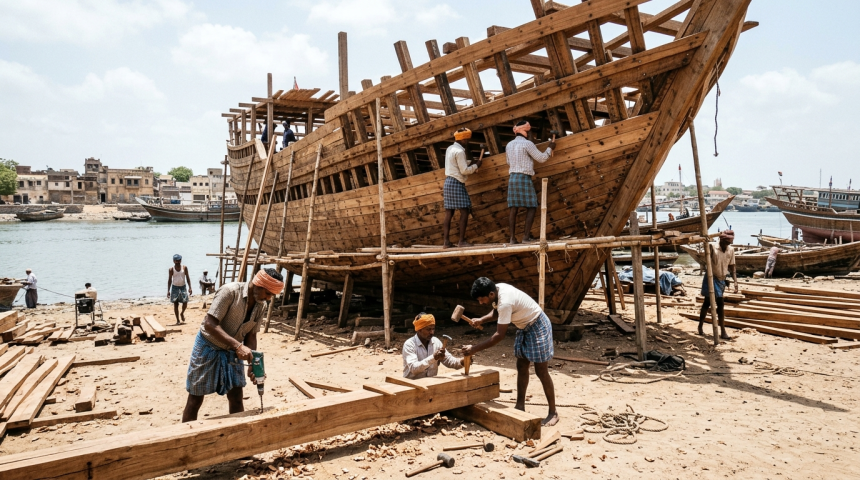
Shipbuilders in Mandvi spend about three years completing each commissioned vessel, keeping alive a craft shaped by technical skill and cultural memory.
The historic port in Gujarat’s Kutch region has supported maritime trade since the 16th century. Its traditional yards show how wooden shipbuilding remains tied to the identity of a coastal community, even as modern production favors speed and standard designs.
A Port Built Around Maritime Trade
Mandvi developed as an important trading port on India’s western coast. Its position near routes across the Arabian Sea linked Kutch with ports in the Persian Gulf, East Africa and the Arabian Peninsula.
Those connections created demand for wooden vessels able to carry cargo across long distances. They also supported generations of carpenters, designers and laborers whose knowledge passed from one workshop to another.
The work is as cultural as it is technical. A vessel reflects local construction methods, practical experience and skills often learned through direct participation rather than formal instruction.
Three Years From Order to Launch
A single commission takes roughly three years to complete. That timetable contrasts with industrial shipyards, where machinery, modular sections and large workforces can shorten production.
Mandvi’s longer process reflects the demands of traditional construction. Shipbuilders must shape and fit major wooden sections while maintaining the vessel’s balance and strength. Each stage affects how the finished ship will perform at sea.
The extended schedule also changes the business model. Builders and customers must plan years ahead, while workshops depend on a steady supply of skilled labor and suitable materials.
- Each commissioned vessel takes about three years to build.
- The trade combines maritime engineering with inherited craft knowledge.
- Mandvi’s shipbuilding history dates to its rise as a 16th-century port.
Knowledge Carried Through Generations
Traditional shipbuilding relies heavily on human judgment. Experienced builders understand how wood behaves, how sections should connect and how a hull must respond to pressure at sea.
That knowledge is difficult to preserve through written plans alone. Apprentices learn by watching experienced workers, handling materials and taking on larger tasks over time.
This system gives the trade cultural depth, but it may also make succession harder. If fewer young workers enter the yards, technical knowledge accumulated over centuries could narrow or disappear.
Commercial Pressure Meets Cultural Value
The three-year production cycle highlights a central tension. Traditional vessels carry historic and cultural value, yet builders must still compete in a market shaped by cost, delivery times and modern materials.
Supporters of the craft may view its slow pace as evidence of care and skill. Buyers, however, must weigh those qualities against the financial demands of a long commission.
Preservation efforts therefore need to consider both heritage and livelihoods. Celebrating the yards as historic sites would not be enough if shipbuilders lacked paying customers, training opportunities or reliable access to materials.
Mandvi’s shipyards remain working links to the port’s maritime past. Their future will depend on whether traditional knowledge can retain commercial use while attracting another generation of workers. The three-year journey from commission to completed ship is not simply a production schedule. It is a measure of the patience, skill and continuity required to keep a centuries-old trade afloat.