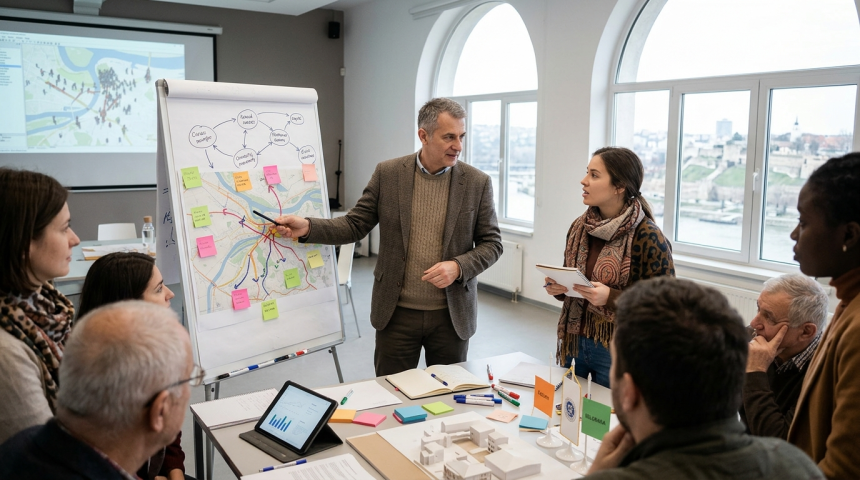
A Serbian academic says an experiment he observed in Belgrade could help European countries respond to unrest, though key details still require public scrutiny.
Aleksandar Matkovic presented the Serbian capital as a possible source of practical lessons for governments and communities facing social tension. His account raises a timely question: Can a local effort in Belgrade offer a useful model elsewhere in Europe?
“I saw an experiment take shape in Belgrade. Its lessons should be studied by other European countries struggling with unrest,” Matkovic said.
The statement does not identify the experiment, its organizers, or its methods. It also provides no measures of success. Those gaps limit firm conclusions, but the argument still points to the value of studying local responses before copying them.
Belgrade as a European Case Study
Belgrade has long served as Serbia’s political and civic center. Public demonstrations and political disputes there can influence debate across the country.
Matkovic’s choice of the word “experiment” suggests an approach that differed from normal policy or protest practices. It may have involved public organization, political action, or a response to unrest. However, no specific description was provided.
Any serious review would need to establish several basic facts:
- Who designed and led the initiative.
- What problem it sought to address.
- How residents and authorities responded.
- Whether tensions, violence, or public disruption declined.
- Which parts could work under different national laws.
These questions matter because unrest varies sharply by place. A response suited to Belgrade may not fit cities with different institutions, policing systems, or political cultures.
Why European Governments May Pay Attention
European countries have faced protests driven by political distrust, economic pressure, labor disputes, and concerns about public institutions. Governments often must protect public safety while respecting assembly and free expression.
Matkovic’s assessment supports a case-study approach. Rather than treating unrest as one shared problem, policymakers could examine how specific communities reduce conflict and maintain civic participation.
Yet officials should avoid adopting a model based on one observer’s positive judgment. Independent evidence would be needed, including records of arrests, injuries, property damage, public participation, and community trust.
The views of protesters, residents, police, local officials, and civil society groups would also be necessary. An initiative seen as effective by one group may feel restrictive or unfair to another.
Evidence Will Determine Wider Value
For Belgrade’s experience to guide policy elsewhere, researchers would need a clear timeline and stated goals. They would also need comparisons with earlier periods or similar cities.
Transparency would help distinguish a lasting result from a short-term change. Researchers should ask whether the experiment reduced the causes of unrest or only changed how public dissent appeared.
Matkovic has placed Belgrade in a wider European discussion about public order and democratic participation. His claim deserves attention, but not uncritical acceptance.
The next step is to document what happened, who benefited, and whether the results endured. If credible evidence supports his assessment, Belgrade may offer practical lessons. If not, its greater value may be as a warning about drawing broad policy conclusions from an undefined local experience.