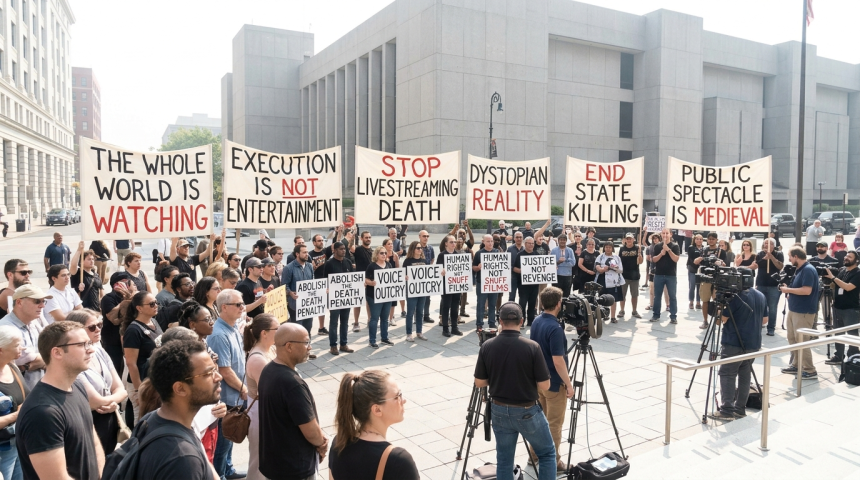
The prospect of a U.S. execution being livestreamed has triggered sharp online criticism, with commentators calling the idea “dystopian” and “medieval.” The proposal raises an urgent question: Can public oversight of capital punishment be separated from public spectacle?
Key details remain unclear, including which jurisdiction may allow the broadcast, who could watch, and whether access would be restricted. Yet the reaction shows how quickly a livestream could shift the debate from execution policy to digital ethics.
Executions Enter the Streaming Age
American executions are usually witnessed by a small group inside a prison. That group may include relatives, journalists, officials, lawyers, and invited observers. Rules differ by state.
A livestream would break with that controlled model. It could give viewers remote access to an event that governments have long kept behind prison walls. Depending on the system, access might range from a secure feed for approved witnesses to a wider public broadcast.
That difference matters. A closed video link could help relatives or reporters who cannot attend. An open stream could place a person’s death on the same devices used for sports, entertainment, and social media. The technology is ordinary. The event is not.
Online commentators described the possibility as “dystopian” and “medieval.”
Those labels reflect two related fears. “Dystopian” points to technology turning state punishment into remote viewing. “Medieval” recalls eras when executions were public events, often staged before crowds.
Public Punishment Has a Long History
Executions in the United States were once conducted in public. Crowds gathered to watch hangings, sometimes in numbers large enough to create security problems and a carnival-like mood.
Over time, executions moved inside prisons. The shift reflected concerns about disorder, cruelty, and spectacle. Capital punishment continued in many jurisdictions, but the audience became smaller and more regulated.
Broadcast technology now tests that settlement. Cameras can expand access without bringing a physical crowd to a prison. They can also create a far larger audience than earlier public executions ever attracted.
The central arguments fall into two camps:
- Supporters of greater access may argue that government killing should not be hidden from public scrutiny.
- Critics may warn that broadcasting death risks exploitation, trauma, and uncontrolled redistribution online.
Transparency Collides With Human Dignity
Capital punishment already faces disputes over fairness, wrongful convictions, execution methods, and the suffering involved. A livestream would add questions about privacy and consent.
The condemned person may oppose being shown. Victims’ relatives may disagree among themselves. Some may want the public to witness the punishment, while others may see the broadcast as another invasion of grief.
Journalists also serve an oversight role. Witness reports can document delays, visible distress, and departures from official procedures. Video might provide a more direct record, but cameras do not settle every factual dispute. Placement, sound quality, interruptions, and government control of the feed could shape what viewers see.
There is also the internet’s long memory. Even a restricted stream could be recorded, copied, edited, or paired with misleading claims. Once released, footage could become impossible to contain. The clip economy is not known for restraint.
Rules Will Define the Real Impact
Any plan would face legal and policy questions. Officials would need to decide who receives access, whether recording is blocked, and what safeguards protect families and witnesses. Courts could also be asked to weigh public access against security and privacy.
The possible livestream does not merely update an old procedure. It challenges the boundary between witnessing state power and consuming another person’s death.
Officials will need to explain the purpose, audience, and controls before moving forward. Without strict limits and a clear public-interest case, the broadcast could revive the very spectacle that indoor executions were meant to leave behind.