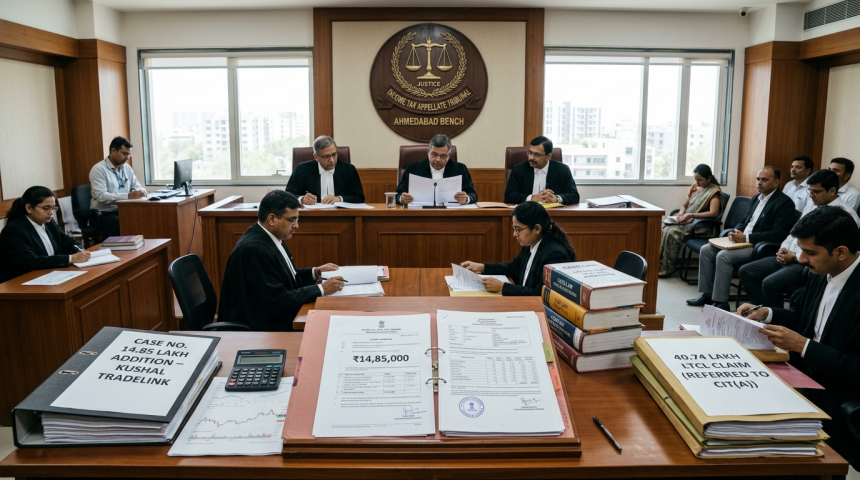
The Ahmedabad Income Tax Appellate Tribunal has upheld a ₹14.85 lakh tax addition linked to trading in Kushal Tradelink shares. The tribunal found that transaction records alone did not prove the gains were genuine. However, it returned a separate ₹40.74 lakh long-term capital-loss claim to the Commissioner of Income Tax (Appeals), known as the CIT(A), for fresh consideration.
The split ruling offers a clear warning for investors facing tax scrutiny. Contract notes and account entries may show that trades occurred, but they may not settle questions about their true nature.
Records Failed to Prove Genuine Gains
The disputed addition arose from share transactions involving Kushal Tradelink. The taxpayer relied on transaction records to support the gains claimed from those shares.
The tribunal was not persuaded that those records, standing alone, established genuineness. It therefore declined to overturn the ₹14.85 lakh addition.
Transaction records alone did not establish the genuineness of gains from Kushal Tradelink shares.
The decision draws an important line between documenting a transaction and proving that it reflects genuine economic activity. A trade may appear in formal records, yet tax authorities can still examine its timing, price movement, counterparties, and surrounding facts.
For taxpayers, this means the paperwork must form a consistent story. Bank statements, demat records, broker documents, purchase history, payment trails, and market data may each play a role. One document rarely carries the entire case on its back.
Capital-Loss Claim Gets Another Hearing
The tribunal reached a different result on the taxpayer’s ₹40.74 lakh long-term capital loss. Rather than deciding the issue finally, it sent the claim back to the CIT(A).
That direction keeps the loss dispute open. The appellate authority must reconsider the claim under the tribunal’s instructions and assess the available facts and evidence.
The referral does not mean the loss has been accepted. It also does not amount to a final rejection. It gives the taxpayer another chance to support the claim, while allowing the tax department to test that evidence.
- ₹14.85 lakh addition: upheld by the tribunal.
- ₹40.74 lakh long-term capital loss: returned to the CIT(A).
- Central issue: whether the records proved genuine transactions.
Why Evidence Matters in Share Cases
Share-trading disputes often turn on the quality of evidence rather than the mere existence of documents. Tax officials may question gains or losses if the trading pattern appears unusual or lacks a credible commercial explanation.
Electronic trades leave extensive records, but volume does not always equal proof. Authorities may compare several pieces of evidence to determine whether the claimed tax result matches the economic reality.
The Ahmedabad ruling also shows that each claim can receive separate treatment. The tribunal sustained the addition related to gains while reopening review of the loss. A weakness in one part of a return does not automatically decide every other issue.
Practical Impact for Investors
Investors should preserve records from the date of purchase through the final sale. They should also ensure that tax returns, bank movements, demat statements, and broker reports agree.
Useful evidence may include:
- Purchase and sale contract notes.
- Demat account statements showing delivery.
- Bank records tracing payments and receipts.
- Broker ledger entries and applicable charges.
- Material explaining unusual price changes or holding periods.
The ruling leaves the taxpayer with a mixed outcome. The ₹14.85 lakh addition remains in place, while the much larger ₹40.74 lakh loss claim returns for review.
The next development will come from the CIT(A)’s reconsideration of that loss. For other market participants, the message is more immediate: records must prove not only that a trade was entered, but also that the claimed gain or loss deserves tax recognition.