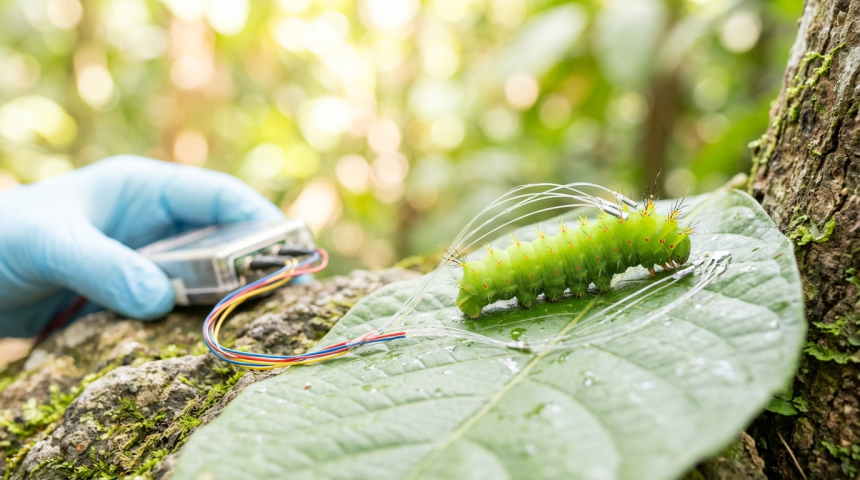
Research into how caterpillars hear could lead to better microphones, linking a long-standing biological question with practical advances in sound technology.
The work has two related goals. Scientists hope to learn how the insects detect sound and use that knowledge to improve devices that convert sound waves into electrical signals.
“The research could do more than help unlock the mystery of caterpillar hearing. It could also help make microphones better.”
The statement points to an early research direction rather than a finished product. No details were provided about the research team, study methods, location, timetable, or microphone design.
Why Caterpillar Hearing Matters
Hearing helps animals respond to threats and changes around them. Studying this process can show how small biological structures detect motion, vibration, or sound.
Caterpillars present an especially interesting subject because their sensory systems differ from familiar human hearing. Researchers may examine how their bodies receive signals and how those signals guide behavior.
The phrase “mystery of caterpillar hearing” also reflects key unanswered questions. Scientists must establish what sounds caterpillars detect, which body structures receive them, and how the insects respond.
Answering those questions requires careful testing. Researchers would need to separate true sound detection from reactions to touch, air movement, ground vibration, or other changes.
Lessons for Microphone Design
Biological research has often informed engineering. Animals can provide useful models for sensing weak signals within tight limits on size and energy use.
If caterpillars use an efficient method to detect sound, engineers may be able to study its basic principles. Those lessons could inform smaller sensors or microphones designed for specific frequencies.
Possible areas of study include:
- Sensitivity to faint sounds or vibrations
- Detection using small, lightweight structures
- Filtering useful signals from background noise
- Response to selected frequency ranges
However, a biological discovery does not directly become a commercial device. Engineers must translate the finding into materials, circuits, and designs that can be produced reliably.
Important Questions Remain
The available information does not show whether researchers have built or tested a microphone based on caterpillar hearing. It also offers no performance data or comparison with existing products.
That distinction matters. A promising biological mechanism may work well inside an animal but prove difficult to copy. Cost, durability, accuracy, and manufacturing limits can shape whether an idea reaches users.
Independent testing would also be needed to confirm any gains. Useful measures could include sensitivity, signal quality, frequency response, energy use, and performance amid background noise.
For now, the research connects basic science with a practical engineering goal. Its immediate value lies in explaining how caterpillars sense their surroundings. Its wider value will depend on whether those findings produce measurable improvements in microphones. Future study results, prototype tests, and published performance data will show how far the idea can travel.