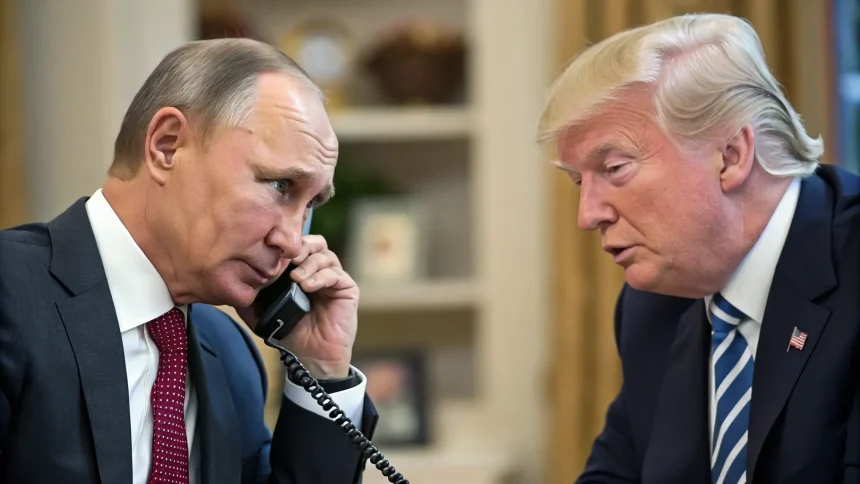
Russian President Vladimir Putin spoke by phone with former U.S. President Donald Trump on Sunday, offering birthday wishes for Trump’s 80th and discussing relations between Moscow and Washington, according to the Kremlin. The call came on June 14, Trump’s birthday, and touched on the state of bilateral ties at a time of prolonged tension.
What Was Said
The Kremlin said the conversation included personal congratulations and a discussion of U.S.-Russia relations. It did not release detailed policy points or a readout of next steps. But the brief description signaled interest in the broader direction of ties between the two countries.
Putin “congratulated him on his 80th birthday and discussed bilateral relations between Moscow and Washington,” the Kremlin said.
The call did not include public remarks from either leader beyond the Kremlin’s statement. No agenda, proposals, or timelines were disclosed.
Why It Matters Now
Phone calls between top political figures often serve as temperature checks, even when no formal negotiations are underway. U.S.-Russia relations have been strained for years, driven by conflicts, sanctions, and diverging security goals. Against that backdrop, even a short exchange can draw attention.
Trump’s past dealings with Putin during his 2017–2021 term shaped public debate over engagement with Russia. He favored outreach at times, while U.S. institutions maintained sanctions and posture shifts in response to Russian actions. Those dynamics still shape how observers read any contact between the two men.
Background on Bilateral Ties
Since 2014, Washington has imposed waves of sanctions on Russian entities and officials. After Russia’s full-scale invasion of Ukraine in 2022, measures expanded to target banks, energy, technology access, and trade. Diplomatic expulsions, restrictions on visas, and limits on investment followed across allied capitals.
Security channels between the two countries continue in narrow areas, such as arms control consultations and deconfliction practices, but formal treaties have eroded. Several agreements that once structured nuclear arsenals and inspections are suspended or under strain.
- Sanctions remain a central tool of U.S. policy toward Moscow.
- Trade flows have contracted since 2022 as restrictions widened.
- Military and intelligence contacts are limited and highly managed.
Public opinion also weighs on policy. In both countries, polling has tracked hardened views since 2014 and again after 2022, further limiting political room for compromise.
Signals and Interpretations
Analysts see two possible readings of the call. First, the exchange may be strictly personal, centered on a birthday greeting with a brief, general nod to state relations. Second, it may reflect ongoing interest in how future U.S. leadership might shape sanctions, security talks, or Ukraine policy, even without immediate policy changes.
Without details of proposals, the safer assumption is that the call was informal. Still, leaders often use such moments to test messages, reaffirm positions, or gauge responses. That can set the tone for later statements or diplomatic moves.
What To Watch Next
Future public comments from either figure could add context, including whether they raised specific issues such as Ukraine, energy, or detainee cases. Any mention of channels for follow-up—formal or informal—would suggest practical implications. Absent that, attention will stay on official U.S. and Russian actions, where sanctions, export controls, and military aid decisions carry the most weight.
Observers will also track whether Moscow highlights the call in domestic media to signal openness to dialogue, or to suggest that contact with prominent U.S. figures remains possible despite deep policy rifts. Such messaging choices can hint at priorities without revealing negotiating lines.
For now, the main takeaway is simple: Putin acknowledged Trump’s 80th birthday and the two touched on bilateral ties, with no public sign of concrete steps. The broader story—sanctions, conflict, and cautious contacts—continues to shape the relationship. Watch for any formal readouts, follow-up calls, or shifts in policy statements that could turn a courteous exchange into the start of something more substantive.