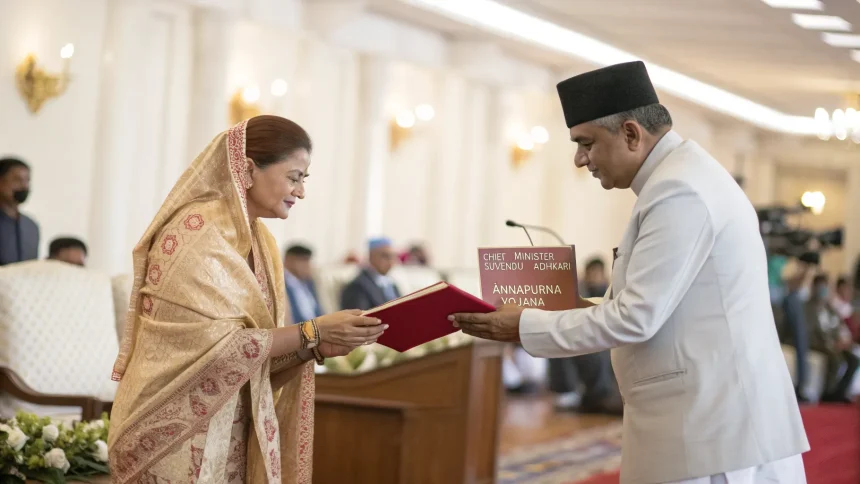
West Bengal Chief Minister Suvendu Adhikari is set to launch the Annapurna Yojana today at 12:30 pm, a cash support program that will provide ₹3,000 a month to women beneficiaries. The government plans to hand out sanction letters to 100 recipients per locality during the inauguration, signaling a rapid, neighborhood-level rollout. The scheme replaces the previous Lakshmir Bhandar initiative and marks a new push on household income support.
The announcement places direct cash transfers back at the center of the state’s welfare agenda. It also raises questions about budget impact, delivery timelines, and how eligibility will be verified at scale.
What the Scheme Offers
The flagship promise is simple cash support paid monthly to women, pitched as a steady income floor for families living with rising costs. Officials say distribution will begin with sanction letters, a first step toward onboarding recipients.
“Providing ₹3,000 monthly to women beneficiaries.”
Organizers have also flagged a staged start to manage applications and bank verification. That suggests a rollout designed to show early progress while the system scales up.
Launch-Day Details and Rollout
The event is scheduled for 12:30 pm, with local sites expected to host small handover ceremonies. The state plans to issue documents to a limited number of people in each area at first.
“100 beneficiaries per locality receiving sanction letters.”
This approach indicates a controlled pilot in multiple neighborhoods at once. It can help identify bottlenecks in paperwork, banking access, or Aadhaar-linked verification before wider expansion.
- Monthly transfer: ₹3,000 to women beneficiaries
- Inauguration time: 12:30 pm today
- Initial coverage: 100 recipients per locality
Replacing Lakshmir Bhandar
State officials say the new program supersedes Lakshmir Bhandar, a prior income support plan for women. That shift signals a policy reset, with the government opting to consolidate efforts under one banner and a higher monthly payout.
“The scheme replaces the previous Lakshmir Bhandar initiative.”
For current recipients, the key questions are simple: how to transition, whether re-application is needed, and when the first payment arrives. Clear instructions on bank linkage and identity checks will matter as much as the headline figure.
Why It Matters
Targeted cash support can cushion shocks for households that face irregular wages and rising prices. For many, an assured ₹3,000 a month helps cover groceries, school fees, or healthcare. Economists often note that direct transfers are quick to deploy and give families the freedom to spend on urgent needs.
But budgets are not bottomless. Expanding coverage and raising payouts raise the state’s recurring costs. That could mean tighter spending elsewhere unless tax revenues grow or other programs are trimmed.
Support and Skepticism
Backers frame the move as overdue relief for women who manage households on thin margins. They argue it will lift consumption in local markets and reduce short-term debt.
Critics question the fiscal math and warn against overlapping benefits without a clean registry. They also want proof that payments will arrive on time, month after month, particularly in districts with patchy bank access.
The Road Ahead
The first test is administrative. Authorities must verify eligibility, prevent duplicate entries, and keep payment schedules predictable. Banking inclusion and grievance redress will decide whether the plan keeps public trust.
Policymakers will also watch how the shift from Lakshmir Bhandar plays out. If the transition is smooth and the new payout lands on schedule, confidence will build. Delays could dent early goodwill.
What to Watch Next
Several signals will show whether the program is on track:
- Clarity on eligibility rules and documentation
- Timeline for first payments after sanction letters
- District-wise coverage targets and monthly progress
- Budget disclosures and cost estimates for the fiscal year
Today’s launch sets an ambitious marker for income support in the state. With a higher monthly benefit and a public kickoff, the government has set clear expectations. The coming weeks will show whether systems and funding can match the promise—and whether households feel the difference where it counts, at the end of the month.