French President Emmanuel Macron is stepping up efforts to bring global technology leaders closer to Paris as France races to build stronger artificial intelligence capacity. The outreach, centered on investment, talent, and research, seeks to turn France into a European hub for AI development while aligning with new EU rules.
The push comes as competition for AI talent and computing power intensifies worldwide. France is pitching its skilled researchers, growing startup scene, and public funding to executives weighing where to expand. The moves span meetings at the Élysée Palace and appearances at major industry events in Paris.
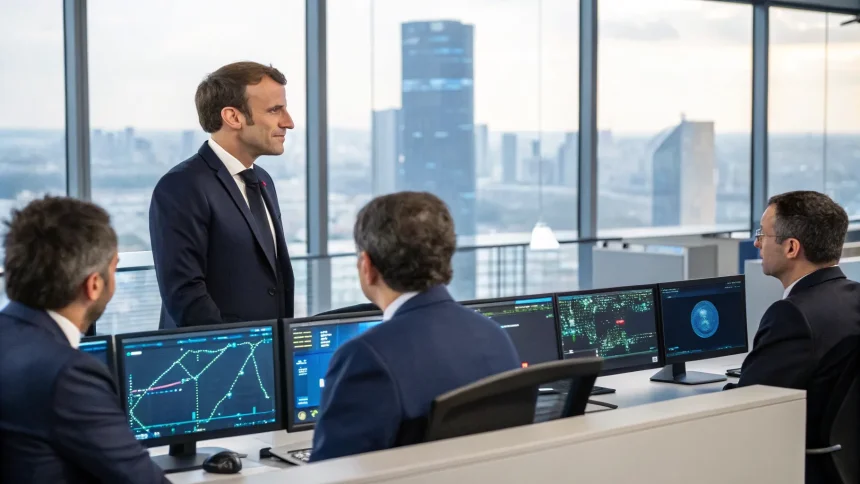
French President Emmanuel Macron has looked to win over tech bosses amid hopes to boost AI capability.
Why France Is Making Its AI Pitch Now
France has raised its profile in AI over the past few years. Paris-based startups have attracted large rounds, while public programs have set aside funds for research and training. The government’s France 2030 plan channels billions into strategic sectors, including AI and chips.
European rules are also taking shape. The EU’s AI Act, approved in 2024, sets risk-based standards for AI systems. Companies are now weighing how to build products that meet those rules while keeping pace with global rivals.
France argues it can balance innovation and safety. Officials point to a deep pool of mathematicians and computer scientists from top engineering schools, as well as national labs and supercomputing assets.
What Tech Leaders Want From Paris
Executives visiting Paris often raise three issues: talent, compute, and clarity on regulation. They seek fast-track visas, predictable energy for data centers, and access to high-end chips. They also want guidance on how the AI Act will apply in practice.
- Talent: Easier hiring, visas, and university partnerships.
- Compute: Reliable, affordable access to GPUs and cloud capacity.
- Rules: Clear standards to reduce compliance risk.
French officials say they are expanding AI training seats at universities and funding new research chairs. Public agencies are working with cloud providers to add GPU capacity. Policymakers are drafting guidance to help startups and large firms meet European rules without slowdowns.
Balancing Growth With Guardrails
Industry groups welcome France’s outreach but warn that heavy compliance could push projects elsewhere. Startups want simple rules for model training and open-source releases. Large firms ask for consistent enforcement across EU countries.
Labor unions and educators urge investment in retraining and digital literacy. They worry about job disruption in customer service, logistics, and back-office work. Consumer advocates push for transparency when AI tools affect loans, hiring, and public services.
Macron’s team says growth and protections can move together. The government promotes sandboxes that let companies pilot tools under regulator oversight. It also backs open research that can be audited and improved by the wider community.
France’s AI Assets—and Gaps
France has strengths in fundamental research, strong mathematics programs, and a cluster of AI startups in Paris. Global companies have set up research labs in the city to tap that talent. Public funds support supercomputing and national data projects in health and transportation.
But challenges remain. Energy prices affect data center plans. Access to top-tier chips is tight worldwide. Some graduates leave for higher salaries in the United States and the United Kingdom. Startups say late-stage capital can be scarce, pushing them to list abroad.
Analysts suggest targeted steps could help: expand talent visas, speed permits for data centers with clear environmental rules, grow late-stage funds, and offer tax credits tied to R&D and hiring.
Signals To Watch In The Months Ahead
The next phase will be measured by concrete moves. Investors will look for new research hubs, hiring commitments, and data center plans announced in Paris. Universities will track enrollment growth in AI programs and industry partnerships. Regulators will publish guidance under the AI Act that defines compliance paths.
France will also need to show progress on compute. Deals that bring more GPUs to public clouds and national research centers will be closely watched. So will collaborations that make open models safer and easier to audit.
Macron’s push is a bid to anchor high-value jobs and research in France while shaping the European market for AI. Success will depend on turning pledges into infrastructure, talent pipelines, and clear rules that companies can use.
For now, the message from Paris is direct: France wants to be a place where AI is built, tested, and deployed at scale. The coming quarters will show whether tech leaders buy in—and whether France can convert momentum into long-term capacity.