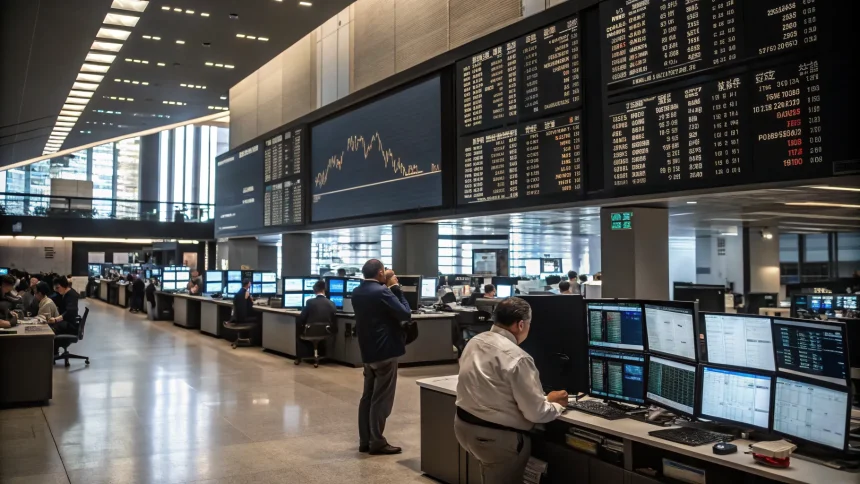
Global stocks paused after recent gains, even as Taiwan Semiconductor Manufacturing Co. joined the $1 trillion market value club and bearish bets gathered around Opendoor. The mixed signals reflect shifting views on rates, earnings, and the durability of this year’s rally. Investors weighed fresh tech leadership against pockets of stress in housing and cyclical shares.
Why Momentum Stalled
Equities cooled as traders reassessed interest rate paths and growth. Sticky inflation in major economies has kept central banks cautious. That leaves valuations sensitive to every data release and earnings update. The pause follows a strong run led by mega-cap technology and chipmakers tied to artificial intelligence demand.
Market breadth remains narrow. Gains have leaned on a small set of leaders, while areas tied to consumer strength, small caps, and traditional banks have lagged. That gap raises questions about the next leg higher if policy relief takes longer than hoped.
TSMC Joins the Trillion-Dollar Club
TSMC’s rise to a $1 trillion valuation cements its role at the center of the chip supply chain. The company manufactures advanced processors for leading customers in smartphones, data centers, and high-performance computing. Its position in producing chips used for AI training and inference has been a key driver of investor enthusiasm.
Only a handful of companies have passed the trillion mark in recent years, including Apple, Microsoft, Alphabet, Amazon, Saudi Aramco, Nvidia, and Meta. TSMC’s addition highlights how chip capacity, yield, and power efficiency have become central to growth forecasts across tech and autos, as well as industrial automation.
Analysts point to large capital spending plans and a move to next-generation process nodes as supports for long-term revenue. Still, concentration risk, geopolitical tension around Taiwan, and cyclical swings in smartphone demand remain chief watch items for the stock.
Short Sellers Circle Opendoor
Opendoor, the home-flipping platform, is drawing increased interest from short sellers. The company buys homes, makes light repairs, and resells them for a spread. That model can be sensitive to mortgage rates, housing turnover, and price volatility. Higher financing costs and slower existing-home sales have made execution tougher across the sector.
Short interest often rises when investors doubt a firm’s path to steady margins. For Opendoor, inventory management and pricing precision are crucial. Small errors in valuation can erase gains if markets move quickly or if holding periods stretch. The company has adjusted its risk controls since past housing swings, but bears argue that thin spreads remain vulnerable.
Bulls counter that improved pricing tools, tighter underwriting, and selective market exposure can defend profits as conditions normalize. Any drop in mortgage rates or pickup in listings could also provide relief. Quarterly updates on inventory turns, per-home contribution profit, and write-downs will be key tests.
Broader Impacts Across Sectors
The day’s crosscurrents reflect a market pulled between AI-driven optimism and rate-sensitive fatigue. Chipmakers and cloud suppliers continue to guide higher on demand for computing power, power management, and networking. On the other hand, housing, small business activity, and consumer discretionary spending have shown mixed signals under tighter financial conditions.
Investors are watching whether earnings strength can broaden. If growth extends past a few mega-caps, indexes may find fresh support even without swift rate cuts. If not, valuation pressures could return, especially in segments that already price in strong outcomes.
What to Watch Next
- Inflation and jobs data that could shift rate expectations.
- Chip supply updates, AI server orders, and capex guidance from major tech firms.
- Housing turnover trends, mortgage rates, and Opendoor’s inventory metrics.
- Market breadth indicators across small caps and financials.
For now, the rally’s leaders remain in focus, with TSMC’s milestone reinforcing the central role of chip capacity in global growth. The pause in momentum signals caution, not capitulation. The next phase will likely hinge on whether earnings extend across more sectors and whether rate relief arrives soon enough to ease pressure on housing and other rate-sensitive areas. Investors should expect more day-to-day swings as data and guidance reset expectations for the second half of the year.