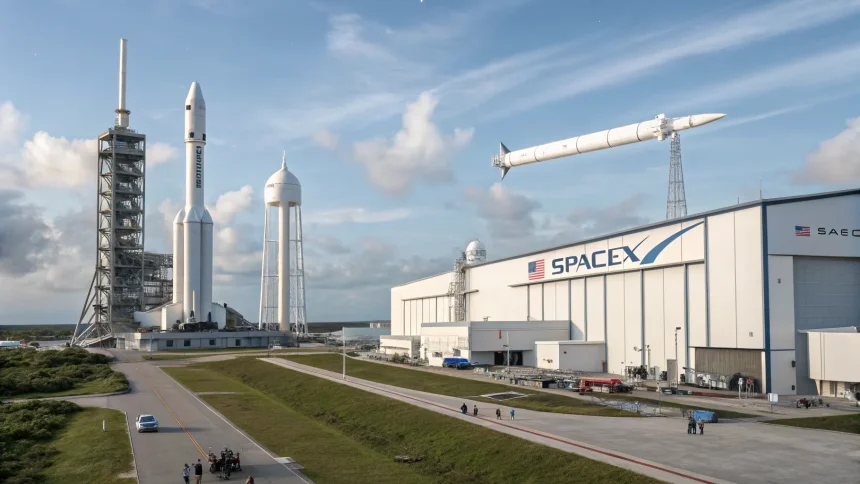
Elon Musk is consolidating more of his companies under SpaceX, adding his artificial intelligence and social media ventures to the rocket maker’s home base. The move, announced this week, signals a tighter alignment of projects shaping how people connect on Earth and in orbit. It raises fresh questions about governance, financing, and the future of consumer and space services.
SpaceX, already a leader in orbital launches and satellite internet through Starlink, is set to become the anchor for an even wider set of operations. Musk also leads the social platform X and the AI startup xAI. The shift is designed to centralize strategy and speed up engineering across hardware, software, and data systems.
“SpaceX, a leader in rocket launches and satellite internet, will now also house Musk’s ventures in artificial intelligence and social media.”
Background: A Growing Web of Ventures
SpaceX has transformed commercial spaceflight with a high launch cadence and reusable rockets. Its Starlink network provides internet service using thousands of satellites and serves customers across many countries. The company is also testing Starship, a heavy-lift system aimed at deep-space missions.
Musk bought Twitter in 2022 and rebranded it as X, pitching an “everything app” that mixes social feeds, payments, and media. He launched xAI in 2023 and introduced the Grok chatbot, positioning it as a research-driven competitor in a crowded AI market.
Pulling these ventures under one roof suggests a stronger connection between the services people use daily and the infrastructure in space that keeps them online. It also reflects Musk’s habit of cross-pollinating talent and technology among his companies.
What the Shift Could Mean
Centralizing leadership and teams could streamline decisions and reduce duplication. SpaceX’s scale and engineering culture may help xAI train models and deploy tools faster. X could tap Starlink’s reach to test features in remote regions and during emergencies.
- Shared data pipelines could speed model training and product rollout.
- Joint infrastructure might lower costs across software and space services.
- Tighter integration may improve reliability for users in hard-to-serve areas.
But there are risks. Combining operations increases the chance of conflicts, especially if resources move from one business to another without clear oversight. It could also draw scrutiny from regulators and investors who want firm boundaries among companies with different missions and capital needs.
Regulatory and Governance Questions
SpaceX works with U.S. agencies on launch licenses, satellite operations, and national security missions. X and xAI face separate rules on content, privacy, and AI safety. Housing them under SpaceX puts varied compliance duties side by side.
Legal experts say any shared services or financing would need strong internal controls. Clear reporting, arm’s-length contracts, and independent audits could limit risk. Customers and partners may ask how data is handled if systems are intertwined.
Investors and lenders will also look at how costs and revenues are allocated. If SpaceX provides facilities or infrastructure to AI or social media units, disclosures will be watched for signs of cross-subsidy.
Why SpaceX Is the Chosen Home
SpaceX has a track record of shipping complex systems under tight timelines. Its operations combine hardware, software, and global logistics. That makes it a natural staging ground for AI tools that need scale and for a social platform that depends on network reliability.
The company also controls Starlink, which can act as both a testbed and a distribution channel. For example, low-latency links can support real-time moderation tools, video features, and emergency alerts where ground networks are weak or offline.
Industry Reaction and Next Steps
Rivals in aerospace and tech are likely to study whether this consolidation yields faster innovation or operational strain. Telecom providers may feel pressure if Starlink pairs tightly with consumer apps. AI firms will watch how xAI uses SpaceX data and compute resources.
Analysts expect early signs to appear in three areas: product speed, service reliability, and cost efficiency. If teams can coordinate launches, network upgrades, and app features on a single roadmap, the combined effort could move quickly. If not, management complexity may slow progress.
The consolidation marks a new phase for Musk’s portfolio, tying social media, AI research, and space infrastructure closer together. The coming months will show whether shared systems deliver faster products and better service, or if the blend brings new risks. Watch for detailed governance plans, disclosures on shared resources, and early product integrations across Starlink, xAI, and X.