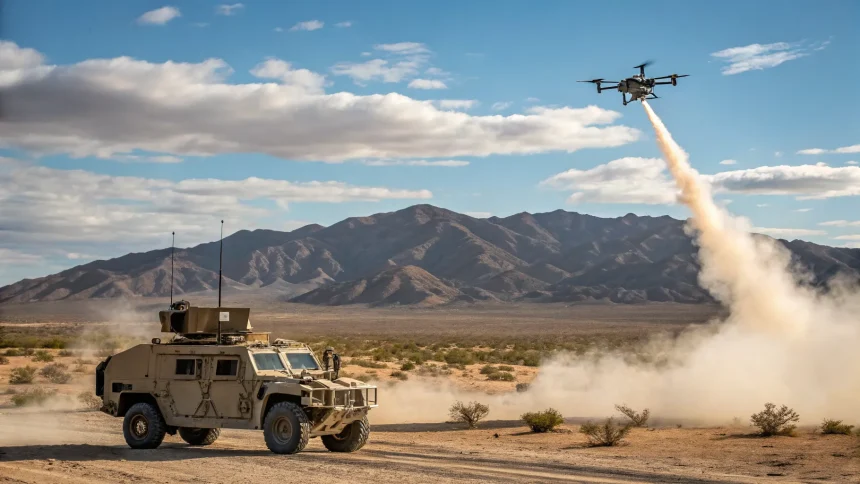
A U.S. military laser weapon reportedly disabled a drone operated by Customs and Border Protection, raising urgent questions about interagency coordination and the safety of directed-energy testing near active operations.
The incident, described by one account as involving a high-energy system against a CBP unmanned aircraft, appears to have occurred during a military activity in U.S. airspace. It is not yet clear when or where the event took place, why the drone was targeted, or whether it was intentional or accidental.
The military reportedly used a laser weapon to take down a drone operated by Customs and Border Protection.
The report, though brief, highlights growing use of directed-energy systems and the risk of friendly-fire incidents as federal agencies expand drone fleets along the border and at test sites.
What Happened and Why It Matters
If confirmed, the takedown would illustrate how lethal effects once limited to kinetic interceptors can now be delivered with light. The episode also points to a complex operating picture in shared airspace where military units, law enforcement, and contractors often fly small drones at the same time.
CBP uses unmanned aircraft for surveillance, search and rescue, and interdiction support. The military tests lasers to defeat hostile drones, missiles, and small boats. Without tight coordination, these missions can collide.
The central questions are basic: Was there a formal test range? Were flight plans deconflicted? Did operators clearly identify the drone as friendly? Answers will shape accountability and future rules.
How Laser Weapons Work and Where They Are Used
High-energy lasers focus power on a target to heat and damage sensors, control surfaces, or airframes. Against small drones, effects can be near-instant if the beam holds steady and has a clear line of sight.
Over the past decade, the services have fielded and tested laser demonstrators on ships, ground vehicles, and fixed sites. The goal is a low-cost, deep-magazine option to defeat swarms and reduce reliance on expensive missiles.
Many systems remain in evaluation. Training and range discipline are essential, since beams can reflect, scatter, or interact with unintended objects if safety measures fail.
Safety, Deconfliction, and Legal Questions
Laser testing requires strict controls, including designated airspace, risk assessments, and coordination with the Federal Aviation Administration. Military units typically publish notices to air missions and maintain visual and sensor-based monitoring to keep skies clear.
CBP aircraft operate under federal law enforcement authorities, while the military follows combatant command and service guidance. Both must comply with FAA safety rules when flying in national airspace.
Key issues for investigators include:
- Identification: How was the drone classified and tracked before engagement?
- Authorization: Who approved weapon use and under what policy?
- Deconfliction: What notices and airspace controls were in place?
- Mitigation: Were non-destructive options considered first?
If a friendly system was struck, the outcome may prompt a review of interagency memoranda, common tracking protocols, and “blue force” identification for drones.
Potential Impact on Border Operations
Even a brief disruption can affect surveillance coverage, migrant rescue efforts, and coordination with local partners. CBP relies on unmanned aircraft to extend reach across remote terrain and waterways.
Loss of a drone can also mean the loss of recorded imagery, sensors, and communications gear. Replacing airframes takes time and money, and gaps can compound if multiple aircraft are grounded for safety reviews.
For the military, an incident involving a partner agency could slow testing schedules and force new checklists for range safety and tracking. It may also accelerate investments in identification, friend-or-foe technologies for small drones.
What to Watch Next
Officials will be pressed to release timelines, locations, and safety logs. Lawmakers may ask how often military lasers have been used stateside and what safeguards exist when other federal aircraft are nearby.
Expect attention on real-time data-sharing between agencies. Shared tracking feeds, common drone identifiers, and geofencing could reduce risk. Training that pairs laser operators with airspace managers will likely expand.
If the report is verified, several outcomes are likely: a joint review, updated firing criteria, and stronger airspace controls around directed-energy events. If it is not, agencies will still face pressure to describe how they prevent friendly-fire incidents as more lasers come online.
The incident signals a simple takeaway. As directed-energy weapons move from trials to daily use, clear rules, shared awareness, and reliable identification will decide whether they add security without new hazards.