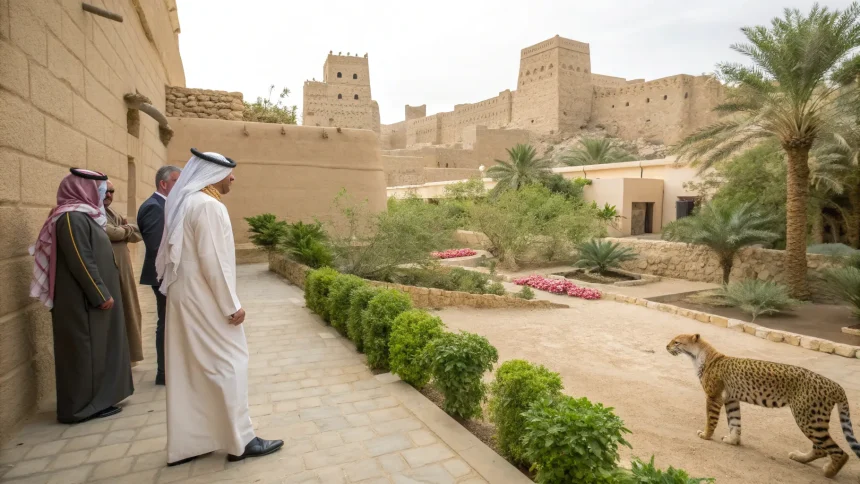
A royal visit to a historic Saudi town placed the critically endangered Arabian leopard back in the spotlight, linking wildlife recovery with heritage renewal in one setting.
During the trip, the prince received an update on a programme to return the big cat to its native range. He also toured a town known for more than 900 mud-brick houses. The visit highlighted how conservation goals and cultural preservation are moving together in the same region.
Race to Save the Arabian Leopard
The Arabian leopard, once roaming across the Arabian Peninsula, is now listed as critically endangered. Conservation groups cite only a small number left in the wild, likely under 200. Habitat loss, hunting of prey species, and human pressures have driven the decline.
In recent years, Saudi-led initiatives and regional partners have stepped up captive breeding and planning for reintroduction. These efforts focus on careful genetics, habitat surveys, and reducing conflicts with people and livestock. Any release plan depends on secure terrain and strong local support.
The prince was told about a programme to bring back the critically endangered Arabian leopard and was also visiting a town which has more than 900 mud‑brick houses.
The briefing sought to connect field science with policy and funding. It also linked leopard recovery to broader environmental goals, including restoring native vegetation and protecting water sources.
Heritage at Stake in a Mud-Brick Town
The town’s more than 900 mud-brick houses form one of the region’s most striking historic clusters. These structures show how people adapted to heat, wind, and scarce water using local materials. Conservation teams have focused on stabilizing walls, repairing roofs, and mapping fragile areas.
Restoring such a district requires skilled labor and patient planning. Conservationists aim to keep original designs while adding safe paths, lighting, and fire protection. Tourism can bring funds for upkeep. It can also strain old buildings if not managed with strict limits.
Linking Conservation and Community
Wildlife recovery is strongest when local communities benefit. Project leaders often stress jobs in guiding, research, and site management. Small businesses can grow around heritage and nature-based travel.
There are trade-offs. More visitors can pressure water supplies and habitats. New roads can cut across movement routes for wild cats and their prey. Conservation plans now tend to include buffers, quiet zones, and rules for vehicle access.
- Wildlife corridors help animals move and find mates.
- Livestock protection reduces conflict with predators.
- Education campaigns build support for releases.
Success also depends on international cooperation. Scientific exchanges share data on genetics, health checks, and release methods. Long-term monitoring can flag problems early, from disease risks to shifts in prey numbers.
Measuring Progress and Risks
Experts often track three indicators: habitat quality, prey abundance, and tolerance among nearby residents. Each must be stable or rising before any release. Pilot studies can test radio collars, feeding behavior, and responses to people.
Heritage projects use different measures. Engineers assess wall stability, erosion, and temperature swings in mud-brick. Managers track foot traffic and set caps in sensitive lanes. Digital mapping helps direct visitors away from weak areas.
Both efforts share one aim: long-term resilience. A revived leopard population needs decades of care. An old town needs careful repairs and money for daily maintenance.
What to Watch Next
The visit signals continued high-level attention. It may speed funding for habitat work and detailed release plans. It could also support training for craftspeople and site stewards in the mud-brick town.
Key steps ahead include confirming target release sites, building community programs, and setting tourism limits near fragile buildings. Clear rules and transparent reporting will be vital to keep public trust.
The day linked two strands of national ambition: protecting a rare predator and preserving a historic place. The outcome will hinge on steady science, careful planning, and local voices at the center.