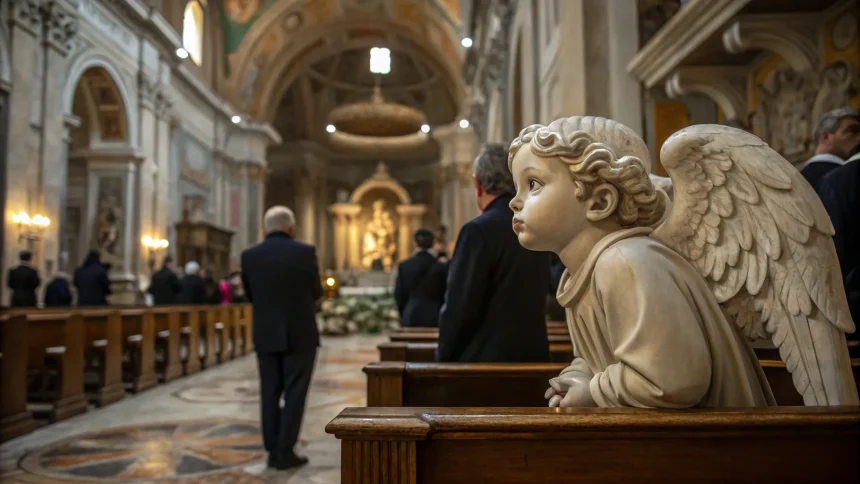
A cherub in a Roman church that resembles Italian Premier Giorgia Meloni has set off a minor scandal, touching nerves in both the sanctuary and the halls of government. The small figure, tucked among sacred art, has become a flashpoint over respect for worship spaces, political imagery, and the thin line between satire and sacrilege. The episode has quickly moved from whispers among parishioners to a national talking point, reflecting deeper tensions over culture and power in Italy.
Background: Politics Meets the Pews
Italy has long wrestled with how politics and Catholic tradition interact. Meloni, who rose to power in 2022, has positioned herself as a guardian of conservative values and national identity. Her government’s cultural posture has fueled heated debates over public funding, school curricula, and historical memory. Religious spaces, meanwhile, remain sensitive theaters where art and devotion must align with liturgical norms.
Visual likenesses in sacred art are not new, and artists have often drawn on real faces to shape angels and saints. But when a prominent leader’s features appear in a church, interpretations multiply. Some see flattery or satire; others see a breach of decorum. This moment sits at that fault line.
How the Image Came to Light
Word of the cherub spread after visitors noticed the resemblance and shared photos on social media. Parish volunteers, according to people familiar with the situation, were caught off guard by the sudden attention. No artist’s statement has circulated publicly, and there is no confirmation that the likeness was intentional.
“The appearance in a Roman church of a cherub that bears a striking resemblance to Premier Giorgia Meloni has sparked a minor scandal for both church and state in Italy.”
The brief description above captures the swirl that followed: curiosity, humor, and a wave of criticism. Some users joked that the cherub was a blessing for the premier. Others called it an inappropriate wink inside a place of prayer.
Church and Government Reactions
Diocesan officials have not announced a formal decision about the artwork. Clergy in Rome often weigh such cases by consulting parish councils, art curators, and canon law advisers. The most common outcomes in past disputes are either retaining the piece with a note of explanation or removing it to avoid distraction from worship.
Government voices, for now, appear cautious. Officials tend to avoid public battles within churches, wary of amplifying the controversy. Aides often stress that sacred spaces should remain nonpartisan, even as political leaders attend Mass and religious ceremonies.
Art, Satire, and the Line of Respect
Art historians say likenesses can be accidental, especially with stylized figures like cherubs. They also note that intentional references in sacred art are fraught, because parishioners expect focus on the divine, not contemporary politics. Free expression advocates, on the other hand, argue that artistic interpretation should not be policed unless it is clearly offensive or disruptive.
Italian churches maintain curatorial control over what hangs on their walls. That control reflects a duty to protect religious meaning, even when public interest pushes for bolder displays. The current dispute highlights how easily a small image can become a national mirror for larger arguments about identity, power, and reverence.
Public Debate and Legal Considerations
Legal experts point out that while censorship is rare, church authorities can request removal if an object distracts from worship or confuses sacred messages. They add that public figures have limited recourse over parody or resemblance unless clear defamation is involved.
- Was the likeness deliberate or coincidental?
- Does the figure interfere with worship or teaching?
- Would removal calm tensions or inflame them?
These questions guide the response as the story evolves. Social media has amplified the dispute, producing more heat than clarity. Yet the decision will likely be made quietly by local church leaders, not by national politicians.
What Comes Next
Several outcomes are possible. The parish could keep the image and issue guidance, remove it and relocate it to a non-liturgical space, or commission a replacement that avoids any modern resemblance. Observers expect the diocese to favor a solution that restores calm while preserving artistic value where possible.
The episode offers a clear takeaway: even small artistic choices can carry outsized political meaning in Italy. As church officials weigh their options, watch for a low-key resolution and a brief note that centers worshippers’ needs. If the image stays, expect continued debate about taste and intent. If it goes, expect a different debate about prudence and pressure. Either way, the conversation about art, power, and respect will not end at the church door.