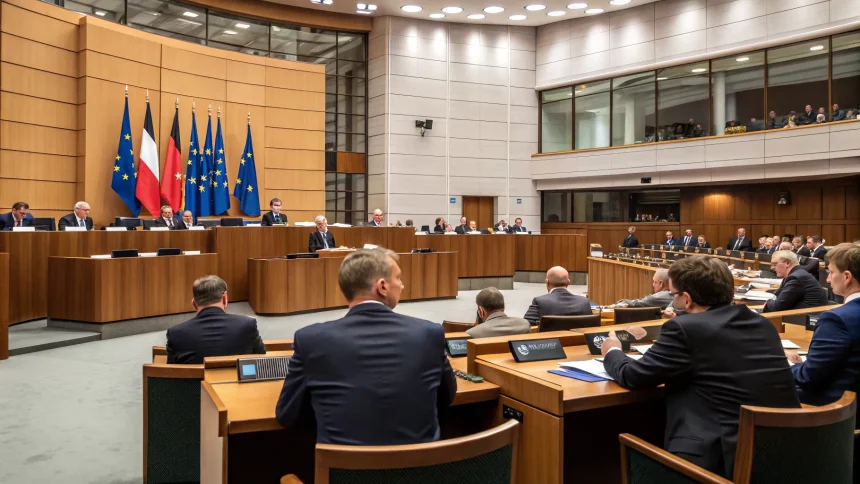
European lawmakers issued a sharp warning after U.S. President Donald Trump threatened tariffs linked to Greenland, igniting a heated session in the European Parliament. The clash, centered on sovereignty and trade pressure, has stirred new friction among the United States, Denmark, and the European Union, and raised concerns about a wider rift over Arctic strategy.
Members of Parliament said the bloc would back Denmark and Greenland amid any tariff-linked pressure campaign. The warning was direct and emphatic.
The confrontation arrives as Washington’s interest in Greenland resurfaces, renewing old disputes and testing transatlantic unity at a sensitive moment for Arctic security.
A Flashpoint in Arctic Politics
Greenland holds a unique place in European and North Atlantic politics. It is an autonomous territory within the Kingdom of Denmark, with its own government and control over many domestic matters. Copenhagen retains responsibility for foreign and security policy.
Trump’s latest tariff threat ties economic pressure to geopolitical aims. EU officials see that as improper leverage over a close partner’s territory. Danish leaders, who have long coordinated with Brussels on Arctic issues, are expected to resist any linkage between trade policy and Greenland’s status.
The uproar recalls 2019, when Trump floated the idea of purchasing Greenland. Denmark rejected the idea. That episode strained relations and highlighted the island’s growing strategic value.
Why Greenland Matters
The Arctic is gaining attention due to climate change, resource access, and new shipping routes. Greenland sits at the heart of these shifts, drawing interest from the U.S., Europe, and other powers.
- Population: about 56,000 people, mostly Inuit.
- Ice coverage: roughly 80% of its surface.
- Strategic site: Thule Air Base supports U.S. and NATO operations.
- Mineral potential: rare earths and other critical materials.
EU lawmakers view the island as integral to North Atlantic security. Any move seen as pressuring Greenland or Denmark could spill into defense cooperation and Arctic governance.
EU and Danish Responses
In Brussels, lawmakers framed the tariff threat as a breach of norms between allies. Some warned that tying trade penalties to territorial aims would invite retaliation and weaken coordination on Russia and Arctic safety.
Danish officials have signaled unity with Greenland’s elected government. Copenhagen has consistently said that decisions about Greenland must respect its autonomy and the kingdom’s constitutional framework.
U.S. officials have not provided detailed timelines or targets for any tariffs linked to Greenland. European trade officials are preparing contingency options if the situation escalates.
Trade Risks and Security Stakes
Tariffs would likely hit transatlantic commerce at a time of already fragile supply chains. European industries could face higher costs, while U.S. importers would absorb price increases. Both sides risk political blowback.
Security cooperation could also suffer. NATO planners rely on close U.S.-EU coordination in the North Atlantic. A tariff fight tied to Greenland could complicate joint exercises, maritime safety, and intelligence sharing.
Analysts say the most immediate risk is diplomatic paralysis. With the Arctic warming and shipping lanes opening, delay in setting shared rules could advantage rival powers.
What to Watch Next
European leaders will press Washington to separate trade measures from territorial and security questions. The EU could seek a formal statement reaffirming respect for Greenland’s status and self-government.
Greenland’s government will aim to preserve economic ties with both Europe and the U.S. while protecting local decision-making over resources. Careful messaging from Nuuk and Copenhagen will be key.
Any move by the White House to define specific tariff categories or timelines would mark a new phase. In that case, Brussels has hinted it would respond through the EU’s trade toolbox, while leaving room for talks.
For now, Europe’s message is clear. The warning that “sovereignty is not for trade” signals a firm line against economic pressure tied to Arctic claims. Whether that stance cools tensions or triggers a deeper standoff will shape transatlantic cooperation in the far north for years to come.