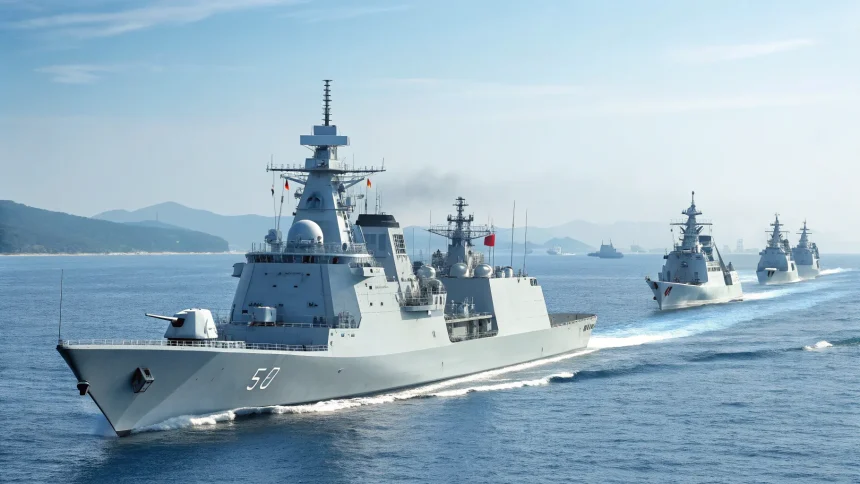
China has introduced eight large Type 055 warships, signaling a faster pace in naval modernization and a stronger blue-water presence in Asia. The ships, each over 10,000 tons, expand the People’s Liberation Army Navy’s ability to escort carriers, defend fleets, and strike at range.
“China has fielded eight 10,000-ton-class Type 055 large destroyers, each capable of carrying up to 112 missiles.”
The move highlights efforts to strengthen air defense, anti-ship, and anti-submarine coverage across key sea lanes. It also adds pressure to regional navies planning future fleets.
Background: A New Flagship for Fleet Air Defense
The Type 055, known in NATO reporting as the Renhai class, serves as the PLAN’s premier surface combatant. Chinese sources call it a destroyer. Many Western analysts label it a cruiser due to its size and command role.
China began sea trials for the first hull, Nanchang, in 2019. More ships followed in rapid order from major yards in Shanghai and Dalian. The class now forms the backbone of carrier strike group escorts.
The ships are designed to protect high-value units, control airspace, and launch long-range strikes. They also improve China’s ability to operate farther from its shores.
What the Ships Bring
- Up to 112 universal vertical launch cells for missiles.
- Modern radar for wide-area air and missile defense.
- Tools for anti-submarine warfare, including sonar and helicopters.
- Command facilities to coordinate task groups.
Missile loadouts can include long-range surface-to-air missiles for fleet defense. They can also carry anti-ship and land-attack weapons, depending on the mission. The universal launch system allows flexible mixes.
Regional Impact and Reactions
The eight ships arrive as the United States retires its aging Ticonderoga-class cruisers. The U.S. Navy still fields advanced Arleigh Burke destroyers, including new Flight III variants. Japan deploys Maya and Atago classes with Aegis systems. South Korea’s Sejong the Great class carries heavy missile loads as well.
Analysts say the Type 055s give China more options in the Western Pacific and Indian Ocean. They can escort carriers, defend amphibious groups, or conduct independent patrols. They also raise the stakes around disputed waters.
Regional planners must now factor in more layered air defense and longer-range anti-ship threats. That affects patrol patterns, logistics routes, and crisis responses.
Capabilities in Focus
The class uses a large radar suite to track aircraft and missiles at long distances. Its sensors support area air defense for a wider perimeter. This helps protect carriers and other vital ships.
Universal launch cells can fire surface-to-air missiles for high-altitude threats. They can also launch anti-ship missiles for sea control. Some reports point to land-attack options that could reach inland targets.
The ships carry helicopters and towed sonar arrays for tracking submarines. That improves underwater defense for carrier groups and convoys.
Comparisons and Trends
By displacement and missile capacity, the Type 055 ranks among the largest surface combatants in service. The U.S. Navy relies more on a larger number of slightly smaller destroyers. Japan and South Korea field fewer ships but carry advanced sensors and interceptors.
Numbers matter. Eight large hulls allow multiple task groups to sail at once. They also enable rotational deployments and training without gaps.
Production speed is another factor. Chinese shipyards have delivered complex warships at a quick pace, shaping timelines for rivals’ procurement plans and maintenance cycles.
What to Watch Next
The next questions involve endurance, training, and integration with carriers. Sustained operations far from home test logistics and crew readiness. Exercises with carriers will show how well the class performs the air defense commander role.
Regional navies will adjust. Expect more focus on cooperative air defense, anti-submarine patrols, and hardened bases. New sensors, unmanned systems, and long-range missiles will feature in response plans.
China’s fielding of eight Type 055s marks a clear shift in surface warfare capacity. The ships add reach, protection, and flexibility to Chinese fleets. For neighbors and the United States, the message is to invest, train, and plan for denser missile and air defense environments. The balance at sea will hinge on sustainment, coordination, and how quickly each side adapts.