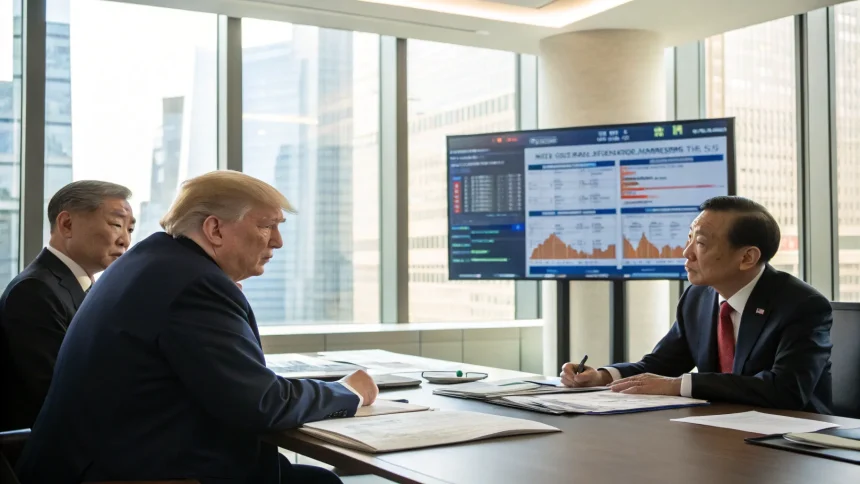
President Donald Trump approved shipments of Nvidia’s H200 artificial intelligence chip to China with a 25% surcharge, reopening a major market for the world’s most valuable chipmaker. The decision could restore billions of dollars in orders while imposing a steep fee on sales to a strategic rival. It signals a new phase in how Washington manages technology trade with Beijing and the flow of advanced AI hardware.
President Donald Trump granted Nvidia Corp. permission to ship its H200 artificial intelligence chip to China in exchange for a 25% surcharge, a move that lets the world’s most valuable company potentially regain billions of dollars in lost business from a key global market.
What the Decision Means
The approval allows Nvidia to sell one of its most advanced data-center chips in China, but at a premium cost. The 25% surcharge functions like a targeted tariff attached to each shipment. It sets a clear price for access to leading U.S. AI hardware while keeping a financial lever in place.
For Nvidia, the move could unlock a large pipeline of delayed or canceled orders. Chinese cloud providers, research labs, and startups have been hungry for high-end AI accelerators. Many turned to slower workarounds or older models after previous curbs. The H200’s return, even with added costs, may reset buying plans across the market.
A Shift in U.S.-China Tech Controls
Washington has spent years tightening rules on advanced semiconductor exports to China, citing national security. Companies introduced modified chips to comply with earlier limits. Demand remained strong despite constraints and uncertainty over future rules.
The surcharge approach suggests a different strategy. Instead of a flat ban, the U.S. is pricing access to top-tier performance. Supporters may see this as a way to monitor shipments, maintain oversight, and capture revenue that can fund domestic priorities. Critics may worry it still advances China’s AI capabilities, even at a cost.
Industry Impact and Market Signals
The decision sends a strong signal to global chip markets. It may ease pressure on gray channels and reduce fragmentation in product lines. It also raises questions about how other U.S. suppliers will be treated and whether similar surcharges will apply to rival products.
Investors will watch whether Chinese buyers absorb the surcharge or delay purchases awaiting clearer rules. If demand holds despite higher prices, suppliers could see stronger margins on China-bound shipments. If not, buyers may prolong reliance on alternative compute or domestic chips.
- Sales resume for Nvidia’s H200 in China under a 25% surcharge.
- Potential recovery of “billions of dollars” in lost orders.
- New template for pricing advanced tech exports over outright bans.
Security, Compliance, and Enforcement
How the surcharge is collected and audited will shape its effectiveness. Licenses, end-use checks, and reporting could remain central to oversight. Clear rules on resales and data-center deployments will matter, given the ease of moving compute capacity across borders and corporate structures.
Security advocates may push for strict caps on performance and shipment volumes. Industry will ask for predictable, timely approvals. Both sides will look for mechanisms to prevent diversion to restricted entities.
What Comes Next
The move could prompt responses from Beijing, including its own conditions or incentives for domestic AI chipmakers. It may also spur competitors to seek similar permissions or lobby for parity. Other U.S. allies could review their export policies to keep alignment with Washington’s new approach.
For now, the central questions are practical. Will Chinese customers accept higher costs in exchange for access to top-tier performance? Can Nvidia ramp supply and support while navigating evolving rules? And will the surcharge model expand to other chips and sectors?
The approval reopens a vital revenue stream for Nvidia while testing a new policy tool in tech trade. If purchases hold, Nvidia could see a swift rebound in China orders despite the extra fee. If they slow, the surcharge may push buyers to wait for clarity or seek local alternatives. Either way, this decision redraws the lines for AI hardware exports and sets a marker for future negotiations over advanced technology between the United States and China.