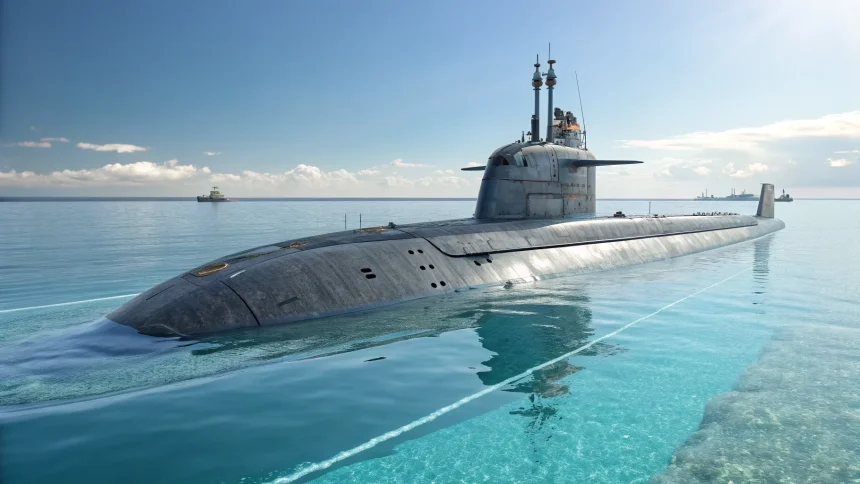
The Royal Navy has fitted a quantum clock to its XV Excalibur robotic submarine, aiming to sharpen underwater navigation without surfacing or relying on satellite signals. The installation marks a step in positioning and timing at sea, where GPS is unavailable and precision is crucial.
The move, announced during a recent technology update, signals a push to harden maritime operations against signal loss and jamming. It also highlights growing interest in quantum timing devices across defense and critical infrastructure. The Excalibur trial is intended to test how long an autonomous submarine can hold an accurate track while fully submerged.
“Why have just one technological breakthrough when you can have two at the same time? The Royal Navy has installed for the first time a quantum clock into its XV Excalibur robotic submarine for extended precise underwater navigation.”
Why Underwater Timing Matters
Submarines cannot access GPS beneath the surface. They rely on inertial navigation systems that drift over time, acoustic beacons with range limits, or periodic surfacing that exposes them to detection. Holding accurate time helps reduce drift and improve dead-reckoning by stabilizing sensors and synchronizing onboard systems.
Quantum clocks offer greater stability than traditional quartz or even many atomic clocks. They use quantum effects in atoms to keep time with very small errors. For an autonomous vessel, better timing can mean fewer corrections and a tighter estimate of position over long missions.
Maritime analysts note that small timing errors add up quickly underwater. Over days, these errors can translate into significant positional uncertainty. A more stable clock can cut that drift, supporting safer navigation, mission planning, and recovery.
How Quantum Clocks Could Change Navigation
Quantum timing is part of a wider push for assured position, navigation, and timing when signals are weak, blocked, or spoofed. Defense agencies in the UK, US, and Europe are testing quantum clocks alongside quantum inertial sensors. The goals are similar: resilient navigation without radio beacons.
Experts say the greatest gains come when improved timing is combined with multiple tools. These include high-grade inertial units, terrain and seabed matching, acoustic fixes, and occasional satellite updates near the surface. The Excalibur trial appears aimed at proving one key piece of that toolkit.
- GPS is unusable underwater; timing helps control navigation drift.
- Quantum clocks may keep time with far less error over long periods.
- Autonomous missions benefit from fewer corrections and lower detection risk.
Strategic Stakes and Industry Impact
For the Royal Navy, accurate submerged navigation supports patrols, mine countermeasures, and intelligence missions. It also aligns with UK investments under the National Quantum Technologies Programme, which has funded research in timing and sensing for several years.
If trials show clear gains, suppliers of maritime systems could see demand for quantum timing modules that integrate with existing navigation suites. Startups and labs working on cold-atom clocks and chip-scale devices may find new customers in naval and commercial fleets.
There are civil uses as well. Survey vessels, offshore energy operations, and undersea infrastructure need precise timing to coordinate sensors and vehicles. Adoption in defense often precedes wider commercial uptake once costs fall and reliability is proven at sea.
Technical Hurdles and Open Questions
Quantum clocks must survive shock, vibration, and temperature changes inside a submarine hull. They also need to be compact, power efficient, and maintenance light. Reliability at sea, not just in the lab, will decide real-world value.
The Excalibur tests will likely measure how much position error is reduced over time, how often the system needs calibration, and what the power trade-offs are. Integration with inertial sensors and control software will be key.
Analysts caution that timing alone does not solve navigation. It narrows error growth but does not provide absolute fixes. A mature system will still blend multiple inputs for the best result.
The Royal Navy has not released performance data. However, the announcement suggests confidence that quantum timing can be packaged for operational trials on autonomous platforms.
The Excalibur trial points to a near-term future where undersea vehicles hold their track more tightly and stay hidden longer. If results are strong, the next steps may include fleet experiments, integration with crewed submarines, and partnerships with UK research institutions. Observers will watch for published accuracy figures, endurance gains, and signs of commercial spin-offs across the maritime sector.