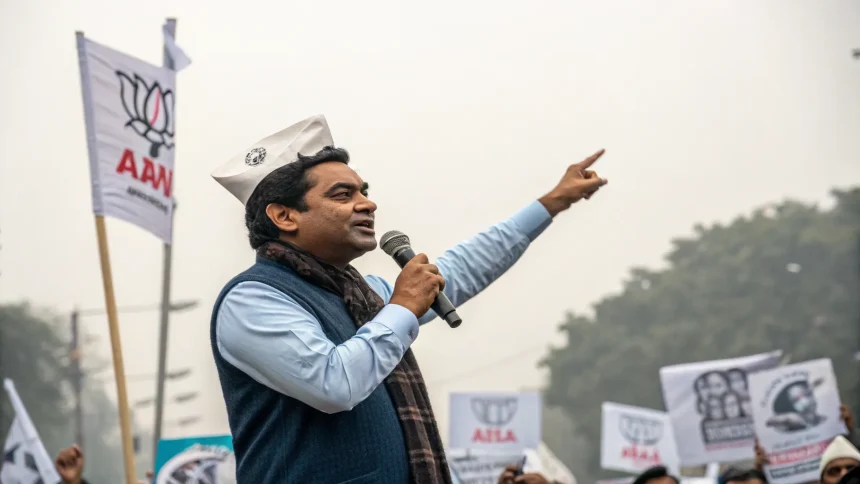
Kapil Mishra stepped up his criticism of the Aam Aadmi Party, urging senior leaders to make Delhi minister Atishi face the press after a heated Assembly episode. He said Atishi made objectionable remarks on January 6 during a discussion on the 350th martyrdom anniversary of Guru Tegh Bahadur. Mishra claimed she has not appeared in public since and called for an apology.
He targeted AAP’s national convener, Arvind Kejriwal, and Punjab Chief Minister Bhagwant Mann. Mishra accused them of shielding Atishi and using the Punjab government’s machinery to avoid media scrutiny. He also circulated a poster to amplify his demand.
Background to the Dispute
The dispute stems from a discussion in the Delhi Assembly tied to the 350th year since the martyrdom of Guru Tegh Bahadur, the ninth Sikh Guru. The occasion holds deep religious and cultural significance for Sikh communities in Delhi and Punjab. Any perceived slight can spark quick reaction across party lines.
Atishi is a senior AAP leader and Delhi cabinet minister. Mishra, a former Delhi minister who later split with AAP, has become a sharp critic of the party’s leadership. He says the alleged remarks crossed a line during an event meant to honor a revered figure.
Mishra alleged Atishi was “avoiding the media” and announced a “MISSING” poster demanding she speak and apologize.
Accusations Against AAP Leadership
Mishra accused Arvind Kejriwal and Bhagwant Mann of shielding Atishi from questions. He claimed they were misusing official channels to keep her out of sight.
He alleged AAP leaders were “deliberately shielding Atishi” and “misusing Punjab government machinery” to limit scrutiny.
He wants a public statement and a direct media interaction from Atishi. He also wants the record of the Assembly discussion made clear in the public domain.
Response and Repercussions
As of publication, there was no public response from Atishi addressing Mishra’s allegations. AAP has not issued a formal reply to his claims in the remarks described here. Without a response, the debate has run mostly on Mishra’s narrative, which his allies have amplified online.
The absence of a clear reply leaves space for political sparring. It also risks overshadowing the original purpose of the Assembly discussion, which was to honor Guru Tegh Bahadur’s legacy. Community leaders may seek assurances that future observances remain respectful and non-partisan.
Wider Political Stakes
The dispute highlights fragile relations between parties in Delhi and Punjab. It also shows how quickly Assembly debates can spill into public campaigns and social media. A single exchange can drive days of messaging and counter-messaging.
- For AAP, questions center on transparency and accountability.
- For Mishra, the push is to keep pressure on party leaders.
- For the public, clarity on what was said and what comes next is key.
If the party responds, it could calm the issue. If it stays silent, the demand cycle may continue, with more posters, press events, and online exchanges.
What to Watch Next
Key developments to monitor include any press appearance by Atishi and an official summary of the Assembly proceedings. A direct statement could set out the context of her remarks. It could also address whether she intends to apologize.
Political observers will also watch for a response from Kejriwal and Mann. Any move by the Punjab or Delhi governments to address the allegation of misused resources would be significant. It could close off one line of attack and shift the focus back to governance.
For now, Mishra’s public campaign has set the agenda. He has framed this as a test of openness around a sensitive anniversary. Whether the issue escalates or resolves may depend on how soon AAP engages with the questions raised.
In the end, the core questions remain simple: what was said in the Assembly, how should leaders handle public concerns about it, and when will the key figures address the matter directly.