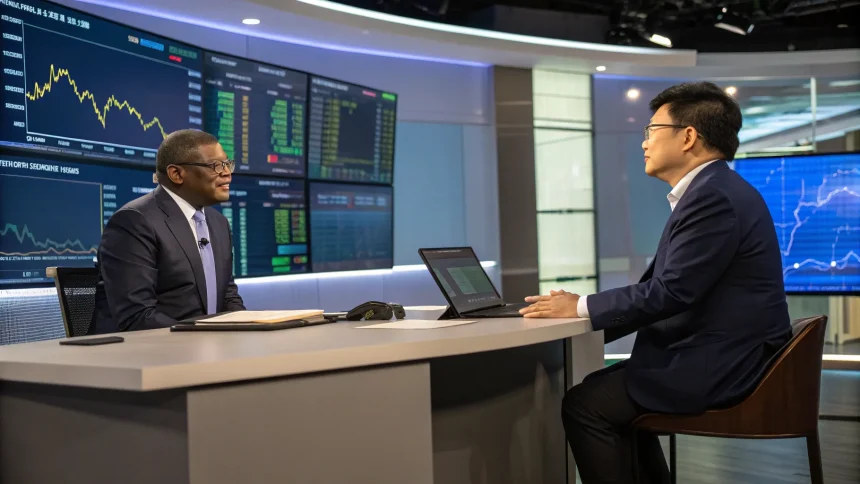
On Fox Business’ Making Money this week, host Charles Payne spoke with BlackRock Global chief investment strategist Wei Li about the market’s surge and the forces behind it. Their discussion centered on technology’s outsized role and the broader drivers Li calls “mega forces.” The conversation arrives as major indexes test record levels and investors weigh how long the rally can last.
Technology firms have dominated stock gains over the past year. Investors have bet on artificial intelligence, software, and chips to deliver earnings growth despite mixed economic signals. Li outlined long-term trends shaping capital flows and corporate strategy, while Payne pressed on how concentrated the market has become and what could broaden it.
Background: A Rally Led by Big Tech
Market leadership has narrowed around the largest technology and tech-adjacent companies. Analysts point to improved profit margins, heavy cash reserves, and strong demand for AI-related tools. The sector now makes up close to one-third of the S&P 500’s weight, magnifying its impact on index performance.
Investors have also grown more confident about inflation cooling and the chance of rate cuts in the coming year. Lower borrowing costs tend to lift growth stocks first, adding momentum to a tech-led upswing. At the same time, manufacturing and small-cap shares have lagged, reflecting uneven activity across the economy.
Technology as the Engine of Gains
Payne asked why tech continues to outpace other sectors despite rich valuations. Li pointed to rising productivity, cloud adoption, and AI integration across industries. These trends help the largest platforms capture more spending while smaller firms race to keep up.
They analyzed the “role of technology in the market rally,” with Li noting that some trends are built to last even through economic shifts.
Supply constraints in high-end chips and data center build-outs have also tightened the link between earnings guidance and stock moves. Companies tied to AI infrastructure often set the tone for sectors well beyond tech.
The ‘Mega Forces’ Shaping Markets
Li framed investing through the lens of long-term drivers. She referred to “mega forces” that steer growth, policy, and capital allocation. These include demographic change, the energy transition, AI and digital adoption, supply chain rewiring, and shifts tied to geopolitics. Each raises new winners and risks within and across sectors.
Li emphasized “mega forces” as a way to think about which business models can compound returns and which may face headwinds.
Technology sits at the center of many of these themes. AI touches health care, finance, autos, and retail. The energy shift pulls in utilities and materials, yet it also depends on software to control demand and improve efficiency. Supply chain moves spur automation and data needs. That creates a tight loop between structural change and digital tools.
Concentration, Risks, and a Path to Broadening
Payne raised concerns about concentration. A small set of stocks drives a large share of gains, which can heighten volatility if sentiment turns. Li noted that long-term forces can justify premium prices, but they do not remove the need for discipline.
- Concentration boosts index returns but increases downside risk.
- Rate moves, earnings cycles, and regulation remain key swing factors.
- Leadership can rotate if credit eases and growth widens.
Some traditional sectors could catch up if financing costs drop and demand stabilizes. Industrials, select financials, and parts of health care may benefit from steady investment and better margins. But any broadening depends on earnings delivery, not just lower rates.
What Investors Are Watching Next
Markets will track quarterly results from major chip and cloud providers, signs of cooling inflation, and central bank guidance. Regulation of AI and data use could reshape profit pools or slow adoption. Supply limits in semiconductors and power infrastructure remain a swing factor for build-out timelines.
Payne and Li agreed that clear cash flow, pricing power, and balance sheet strength matter most if volatility rises. Investors are hunting for companies that can self-fund growth and maintain investment through different rate settings.
The takeaway is straightforward. Technology continues to power the market, but its leadership rests on real earnings. Li’s “mega forces” lens offers a way to separate durable trends from short-term noise. If profits stay strong and policy risk stays contained, the rally can extend. If growth cools or regulation tightens, leadership could rotate. The next few quarters will test whether tech’s gains can spread to the rest of the market—or stay concentrated at the top.