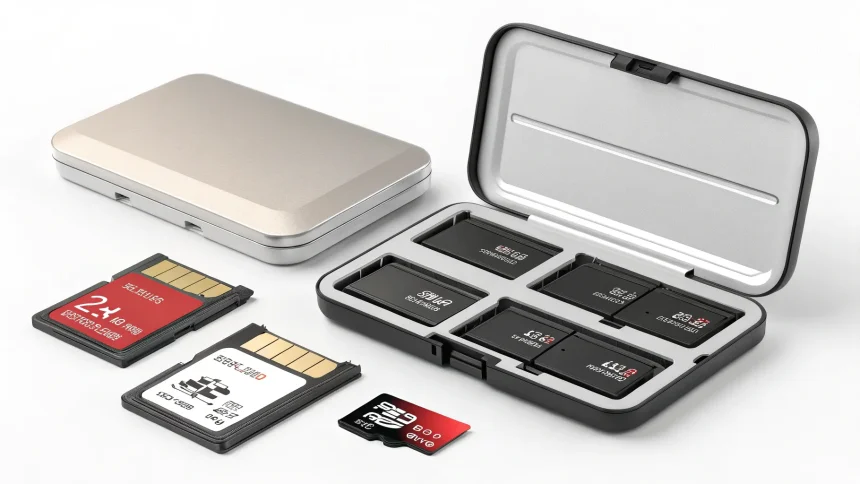
The storage industry is expanding its offerings with the introduction of new microSD Express cards and accompanying cases. This development represents the latest advancement in portable storage technology, providing consumers and professionals with enhanced options for data management.
microSD Express cards combine the small form factor of traditional microSD cards with the faster transfer speeds associated with PCIe and NVMe technologies. These new storage solutions are designed to meet growing demands for quick data access and transfer in mobile devices, cameras, drones, and other compact electronics.
Technical Advancements
The new microSD Express format builds upon the SD Association’s specifications, which were first announced in 2019. These cards utilize PCIe lanes and NVMe protocols to achieve significantly higher read and write speeds compared to traditional microSD UHS-I or UHS-II cards.
Industry experts note that these cards can potentially reach speeds of up to 985 MB/s, making them suitable for high-bandwidth applications such as 8K video recording, advanced gaming, and AI processing on mobile devices.
The physical dimensions remain identical to standard microSD cards, maintaining backward compatibility with existing devices, though the full speed benefits require compatible hardware with the appropriate interface.
Storage Cases and Accessories
Alongside the new cards, manufacturers are releasing specialized cases designed to protect and organize these valuable storage components. The protective cases feature:
- Water-resistant designs to prevent moisture damage
- Impact-resistant materials for drop protection
- Anti-static properties to safeguard against electrical discharge
- Compact designs for portability
Some case models include additional features such as card readers, USB-C connectivity options, and multi-card storage capabilities, catering to professional photographers and videographers who manage multiple cards in the field.
Market Impact
The introduction of microSD Express cards represents a significant step forward in portable storage. Market analysts predict strong adoption in premium smartphones, action cameras, and professional recording equipment over the next two years.
“These new storage solutions address the bottleneck issues that content creators face when working with high-resolution media,” said a spokesperson from a leading storage manufacturer. “The speed improvements will be particularly valuable for applications requiring real-time data processing.”
Initial pricing for microSD Express cards is expected to carry a premium over conventional microSD cards, with costs likely decreasing as manufacturing scales up and market adoption increases.
Consumer electronics manufacturers are already announcing compatibility with the new format in upcoming device releases, suggesting growing support for the technology across multiple product categories.
While the technology offers clear advantages in speed and performance, industry observers note that the transition to widespread adoption may take time as hardware manufacturers update their devices to support the new interface standards.
For professionals working with data-intensive applications, the improved transfer speeds could translate to significant time savings and workflow improvements, particularly when handling large files or performing multiple transfers.